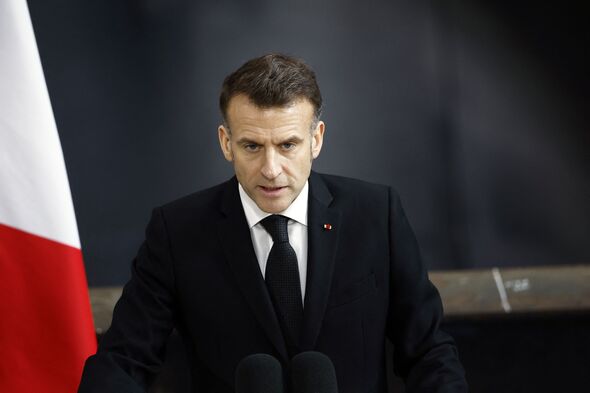
French President Emmanuel Macron has announced a significant shift in France’s defense strategy, proposing the temporary deployment of nuclear-armed jets to the United Kingdom and other participating European nations. During a speech at Île Longue, France’s nuclear base, Macron emphasized the need for enhanced nuclear deterrence in response to evolving security challenges across Europe.
In his remarks, Macron stated, “We must strengthen our nuclear deterrent in the face of multiple threats, and we must consider our deterrence strategy deep within the European continent, with full respect for our sovereignty.” This new approach, which he referred to as “advanced deterrence,” will involve the gradual implementation of strategic air force deployments, including nuclear-capable aircraft, to countries willing to participate.
The announcement aligns with the Northwood Declaration, signed between France and the UK in July 2023. This agreement confirmed that while each nation maintains independent nuclear capabilities, there is potential for coordinated efforts. France’s stockpile is currently estimated at just under 300 warheads, while the UK possesses approximately 225 warheads as of 2025.
Strategic Air Forces and European Security
Macron’s plan includes participation from eight countries: the United Kingdom, Germany, Poland, the Netherlands, Belgium, Greece, Sweden, and Denmark. Both Germany and Poland have expressed a desire for protection under France’s nuclear umbrella, which may lead to the deployment of jets in those nations rather than the UK.
“Our strategic air forces will thus be able to spread out across the European continent,” Macron explained. He described the military strategy as a “dispersion like an archipelago of force,” aiming to complicate adversaries’ strategic calculations and enhance overall deterrence capabilities.
During his state visit to the UK in July 2023, Macron and UK Labour Party leader Sir Keir Starmer pledged to strengthen collaboration on nuclear deterrence. This commitment extends beyond nuclear coordination; Macron also indicated that Germany, the United Kingdom, and France would collaborate on long-range missile projects under the European long-range strike approach, known as ELSA. This initiative seeks to develop advanced conventional strike systems to counteract Russia’s expanding missile arsenal.
Global Context and Future Implications
Macron’s strategy represents the first increase in France’s nuclear warhead stockpile since the 1990s. This shift comes amid concerns regarding the collapse of global nuclear governance, prompting a reevaluation of France’s role in European security.
As Europe faces a complex security environment, Macron’s proposals signal a significant evolution in defense policy that could reshape the continent’s nuclear landscape. By allowing the deployment of nuclear assets across allied nations, France aims to bolster its deterrent capabilities while enhancing collective security in Europe. The implications of this policy will likely influence defense discussions within NATO and among European Union member states in the coming years.