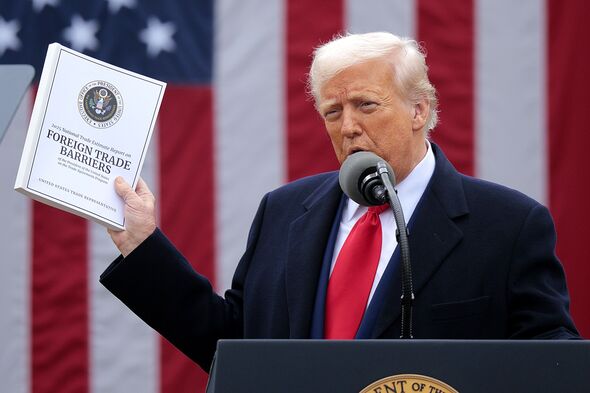
Donald Trump’s authority appears to be weakening following a recent Supreme Court ruling that declared his unilateral tariff policies unconstitutional. In response, the President announced plans to impose a new 10% tariff on imports, which he subsequently raised to 15% through a post on Truth Social. This announcement came shortly after the Supreme Court’s decision to block his previous import tariffs on March 15, 2024.
Professor Rajneesh Narula, an expert in International Business Regulation and global trade policy, commented on the implications of this ruling. He stated that Trump is likely to face increasing domestic pressure as a consequence. In an interview with the Daily Express, Narula explained, “Trump will almost certainly look for a workaround — this ruling was widely expected.”
Narula pointed out that the intended outcomes of Trump’s tariffs have not materialized, saying, “The reality is that his tariff policy has been placing the greatest strain on domestic consumers rather than achieving its intended external impact.” He likened the situation to “a classic case of the emperor having no clothes,” suggesting that acknowledgement of the policy’s shortcomings is overdue.
Following the ruling, Trump expressed his disappointment, stating he was “absolutely ashamed” of the justices who voted against his tariffs. He criticized the decision as “incorrect,” but remained defiant, asserting, “It doesn’t matter because we have very powerful alternatives.”
Polling data further illustrates the shifting public sentiment. A recent YouGov poll indicated that 60% of Americans either strongly or somewhat approve of the Supreme Court’s decision, while only 23% expressed opposition. Additionally, a majority of respondents from Pew Research Center surveys indicated they expect the impact of the tariff policy to be largely negative for both individuals and the nation overall.
Narula emphasized that many Americans had hoped the tariffs would bolster the domestic economy and reduce prices, but this expectation has not been met. “Combined with the court’s pushback, this moment could mark the beginning of a broader domestic pushback to Trump’s economic supremacy,” he noted.
As the political landscape evolves, the potential for domestic resistance to Trump’s economic policies is becoming evident. Narula concluded, “In the immediate term, if Trump continues to pursue workarounds, little may change. But the foundations of the policy and the authority behind it are clearly beginning to crack.”
The developments surrounding Trump’s tariffs and the Supreme Court decision could significantly influence his administration’s economic strategy and overall support among the American public in the coming months.