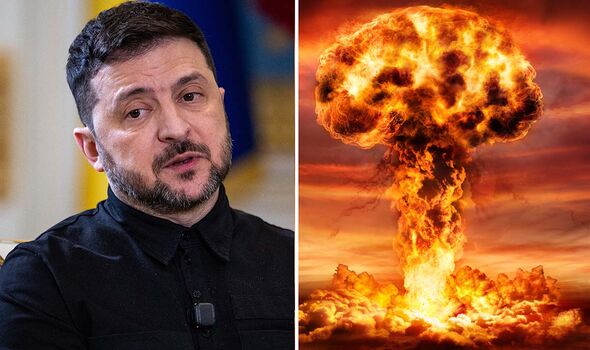
Ukraine’s President Volodymyr Zelensky has asserted that Vladimir Putin has already initiated a global conflict, which he classifies as World War Three. In a recent interview at Kyiv’s government complex, Zelensky emphasized that the only way to counter Russia’s aggression is through significant military and economic pressure. He firmly dismissed proposals for Ukraine to relinquish occupied territories in exchange for peace, arguing that Putin’s ambitions extend far beyond Ukraine.
During the interview, Zelensky articulated his belief that Russia’s territorial aspirations pose a threat to global stability. “I believe that Putin has already started it. The question is how much territory he will be able to seize and how to stop him,” he stated. He further highlighted that Russia seeks to impose its version of life on the world, undermining the freedoms that people have chosen for themselves.
Tensions escalated over the weekend when Dmitry Peskov, the spokesperson for the Kremlin, issued a nuclear warning directed at a NATO member country. Specifically, he cautioned Estonia against the deployment of nuclear weapons on its territory, stating, “If there are nuclear weapons on Estonian territory aimed at us, then our nuclear weapons will be aimed at Estonian territory.” This statement indicates the precarious nature of security in the region, especially following Estonia’s announcement on February 18 that it is open to hosting NATO nuclear arms if deemed necessary.
Zelensky faced mounting pressure from Western analysts suggesting that military victory for Ukraine may be unattainable without making concessions to Russia. Nonetheless, he remained resolute, asserting that Ukraine will ultimately triumph rather than capitulate. He categorized Putin’s demands for a ceasefire as unacceptable, arguing that halting Russia’s campaign is critical not only for Ukraine but for the global community as a whole. “I believe that stopping Putin today and preventing him from occupying Ukraine is a victory for the whole world,” he remarked.
Moscow has demanded that Ukraine withdraw from significant portions of the eastern Donetsk region, along with areas in Kherson and Zaporizhzhia. When asked about the possibility of conceding land to halt the conflict, Zelensky rejected the notion, describing it as akin to abandonment. He expressed concern that yielding territory would weaken Ukraine’s position and fracture societal unity. “I see this differently. I don’t look at it simply as land. I see it as abandonment – weakening our positions, abandoning hundreds of thousands of our people who live there,” he stated.
The prospect of a ceasefire, according to Zelensky, would only provide the Kremlin with a temporary reprieve to regroup and rearm. He suggested that any pause in hostilities would merely allow Putin time to strengthen his military capabilities, stating, “It would probably satisfy him for a while… but once he recovers, our European partners say it could take three to five years. In my opinion, he could recover in no more than a couple of years.”
Amid increasing voices from political circles arguing that Ukraine must negotiate with Moscow, Zelensky pointed to the very location of the interview as evidence of Ukraine’s resilience. “Where are you now?” he posed to the interviewer. “Today you are in Kyiv, you are in the capital of our homeland, you are in Ukraine. I am very grateful for this. Will we lose? Of course not, because we are fighting for Ukraine’s independence.”
When directly questioned about whether achieving victory necessitates reclaiming every inch of lost territory, Zelensky acknowledged that Ukraine would ultimately restore its borders but cautioned that the human cost of doing so immediately would be catastrophic. “We will do it. That is absolutely clear. It is only a matter of time. To do it today would mean losing a huge number of people – millions of people,” he explained.
He concluded by emphasizing that the return to Ukraine’s borders as they were in 1991 is not only a matter of national pride but also an issue of justice for the global community. “Ukraine’s victory is the preservation of our independence, and a victory of justice for the whole world is the return of all our lands,” he asserted.