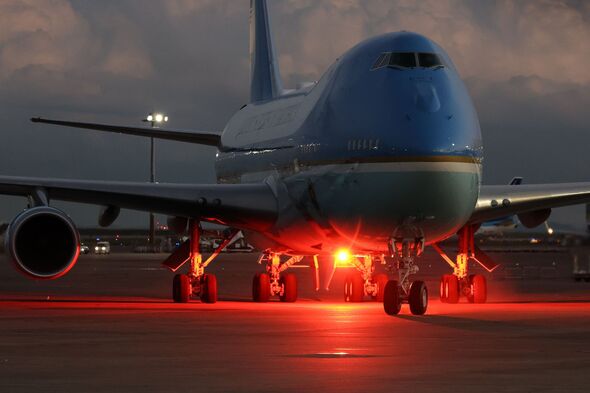
As global tensions escalate, the United States has mobilized former President Donald Trump’s emergency command aircraft, the Boeing E-4B Nightwatch. This aircraft was moved to Washington D.C., serving as a critical command post for senior officials during potential crises, particularly in scenarios involving nuclear conflict. Flight tracking data confirmed the aircraft departed from Omaha, Nebraska, on the evening of March 12, 2024, landing at Camp Springs in the capital’s outskirts.
The recent movement of the E-4B comes on the heels of a significant military operation in Venezuela, where U.S. special forces captured the country’s leader, transporting him to New York to face drug charges. This operation has drawn international scrutiny, particularly from Russia, which has voiced strong objections to U.S. actions in the region. Just hours after the operation, U.S. forces seized an oil tanker, the Marinera, that was flying the Russian flag and had reportedly evaded a U.S. naval blockade.
Russia’s Response and International Implications
The seizure of the Marinera prompted an immediate backlash from Moscow. Russian officials, including Kremlin adviser and former Deputy Foreign Minister Andrei Fedorov, condemned the action, stating that “no state has the right to use force against vessels duly registered in the jurisdictions of other states,” referencing the United Nations Convention on the Law of the Sea. Fedorov warned that such actions could escalate tensions between the U.S. and Russia to a “very critical or maybe even crisis situation.”
In a statement to BBC Radio 4, Fedorov indicated that Russian submarines had been dispatched to the area, noting they would not engage U.S. forces directly but could cause “technical difficulties,” including potential collisions. This escalation has raised fears of a broader conflict, with implications that could resonate well beyond the immediate region.
Strategic Importance of the E-4B Nightwatch
The E-4B Nightwatch serves as the U.S. military’s airborne national command post, designed for rapid deployment to ensure continuity of command in various scenarios. While its primary function is to maintain operational readiness during nuclear threats, the aircraft has also been employed in domestic operations, such as facilitating Federal Emergency Management Agency (FEMA) personnel during disasters. Its latest deployment underscores the urgency of maintaining strategic readiness amid global uncertainties.
Typically based at Offutt Air Force Base, the E-4B moves frequently to support military operations and maintenance, with past deployments to locations like Kelly Field in Texas and Peterson Space Force Base in Colorado. On March 12, the aircraft took off at 16:50 ET and remained airborne for nearly three hours, highlighting its versatility and importance in national defense.
The current geopolitical landscape, marked by escalating tensions between the United States and Russia, has heightened the significance of such military assets. The mobilization of the E-4B Nightwatch reflects a proactive stance by U.S. officials in response to emerging threats, aiming to reinforce command and control capabilities in potential crisis situations.