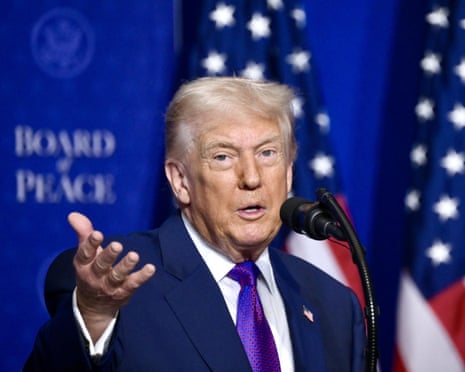
The United States has unveiled a proposal for a multinational force to oversee postwar reconstruction in Gaza, which includes troops from Albania, Indonesia, Kazakhstan, Kosovo, and Morocco. This announcement came during the inaugural meeting of Donald Trump’s newly formed Board of Peace in Washington, D.C. The initiative faces scrutiny as it hinges on the full disarmament of Hamas and requires support from Israel, raising doubts about the board’s ability to deliver on its ambitious vision.
During the summit, President Trump announced a commitment of $10 billion to a fund aimed at reconstructing Gaza. He described this investment as a modest step towards “achieving the dream of bringing lasting harmony to a region tortured by centuries of war, suffering, and carnage.” The financial contributions are set to include $7 billion from several Middle Eastern countries including Azerbaijan, Bahrain, and Saudi Arabia, alongside $2 billion from the United Nations and $75 million from FIFA.
In his opening remarks, Trump expressed confidence in the board’s capability, stating, “We’re going to straighten out Gaza, we’re going to make Gaza very successful and safe.” He also hinted at a broader agenda, suggesting that the board could extend its efforts to address other global hotspots.
General Jasper Jeffers III, appointed to lead the proposed International Stabilisation Force (ISF), detailed plans to deploy 20,000 soldiers across five sectors in Gaza, beginning with Rafah. The long-term goal is to establish a police force of 12,000 officers, with support from Egypt and Jordan for training initiatives. Indonesia’s President Prabowo Subianto indicated his country’s readiness to contribute as many as 8,000 troops, stating, “We are prepared to offer more if necessary.”
The board’s plans have sparked controversy, particularly regarding the establishment of a 5,000-person military base over more than 350 acres in Gaza. Aid workers have voiced concerns about the lack of direction from the board’s National Committee for the Administration of Gaza, noting that an ISF office in the territory remains unstaffed. The absence of clear rules of engagement further complicates the situation, as a political resolution remains elusive.
Yakir Gabay, a Cypriot-Israeli billionaire leading reconstruction efforts, outlined ambitious plans to remove over 70 million tonnes of debris and unexploded ordinance, envisioning the Gaza coastline as a “new Mediterranean Riviera” featuring 200 hotels and potential island developments. Gabay emphasized that these plans are contingent upon the complete disarmament of Hamas.
The initiative has drawn criticism as a shadow UN, with major European allies, including the UK, France, and Germany, opting not to participate. The Vatican has also confirmed its absence from the board. Israeli Prime Minister Benjamin Netanyahu, under pressure from right-wing coalition allies to maintain a hardline stance, did not attend the summit. Instead, his Foreign Minister, Gideon Sa’ar, reiterated Israel’s security concerns and emphasized the need for the “disarmament of Hamas and Islamic Jihad” as part of any future plan.
In a wide-ranging speech, Trump recounted his administration’s efforts to resolve multiple conflicts since taking office, including military actions against Iran. He alluded to potential future actions, stating, “We may have to take that a step further, or we may not.” Trump expressed optimism about ongoing discussions, asserting that significant agreements with Iran have historically proven challenging.
The meeting reflects the US’s growing military presence in the Middle East, where it has amassed two aircraft carriers and numerous warplanes in anticipation of a possible confrontation with Iran. As world leaders and delegates from predominantly Middle Eastern and Asian countries convened, Trump stated, “The US has brought peace to the Middle East by launching strikes on Iran’s nuclear facilities,” suggesting that the outcome of these efforts would unfold in the coming days.