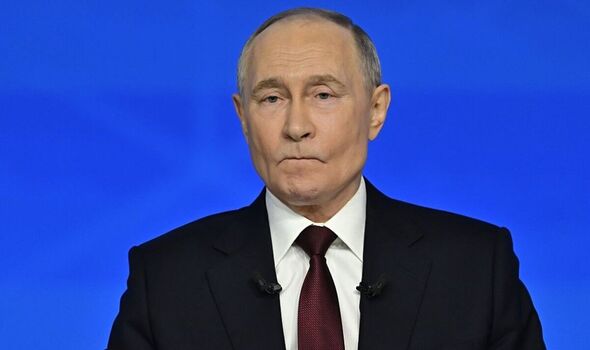
Vladimir Putin’s regime in Russia is increasingly viewed as unstable, with prominent voices predicting its imminent collapse due to escalating regional tensions. According to Nastya Rodionova, a former political journalist now living in exile in France, the situation resembles a “Frankenstein monster,” destined to fail under the weight of its internal contradictions. Rodionova, who fled Russia following the full-scale invasion of Ukraine in February 2022, has become a vocal critic of the Kremlin, sharing her insights on the political landscape from abroad.
Rodionova described her decision to leave her life in Moscow as a necessary choice for her family. She was alarmed by the indoctrination her children faced in school, where they were taught that Russia was “saving Ukrainians from Nazism.” She stated, “I realized that if I stayed in Russia, I would not be able to stay silent, and eventually I would end up in prison.” Her departure reflects a broader concern among Russian dissidents regarding state control and censorship.
Regional Disparities and Political Failures
Rodionova’s experiences as a journalist have shaped her understanding of the political failures in Russia. She witnessed the protests that arose in 2011 when Putin announced his candidacy for a third presidential term. Her disappointment grew as she observed the lack of resolve among protesters when faced with a government crackdown. “We saw the political failure of the middle class during the 2011–2014 protests,” she remarked, noting how even educated urbanites struggled against what she described as a swift transition into dictatorship.
Although there was a resurgence of hope during subsequent protests led by youth inspired by anti-corruption activist Alexey Navalny, these movements also faltered under new repressive laws. Despite the disheartening past, Rodionova holds on to the belief that the regime cannot endure indefinitely. She stated, “Corruption, poverty, censorship, and even war have not mobilised protest in Russia,” but pointed to the growing disparities between regions as a potential catalyst for change.
Russia’s diverse population consists of over 190 ethnic groups and is administratively divided into 89 regions, which include 21 self-governing ethnic republics. Each region possesses its own unique identity and cultural heritage, contributing to the country’s complex socio-political landscape. Rodionova emphasized that these regions, often treated uniformly by the central government, are becoming increasingly aware of their distinct identities and pride.
Financial Strains and Regional Discontent
As the war in Ukraine continues, financial strains on Russia’s regions are becoming more pronounced. Reports indicate that 56 regions are facing significant budget deficits, exacerbated by the diversion of government resources to support military efforts. This situation has resulted in inadequate funding for essential public services like health and education, leading to growing discontent among citizens.
Rodionova warns that the Kremlin’s attempts to impose a singular national identity may not hold as regional disparities deepen. “Each of these worlds has its own identity, its own pride. I see potential in that,” she stated, suggesting that the internal divisions could ultimately contribute to the regime’s undoing.
The future of Russia remains uncertain, yet the voices of dissent like Rodionova’s highlight the growing discontent with the current political order. As regional tensions rise and financial pressures mount, the potential for significant change in Russia appears increasingly likely.