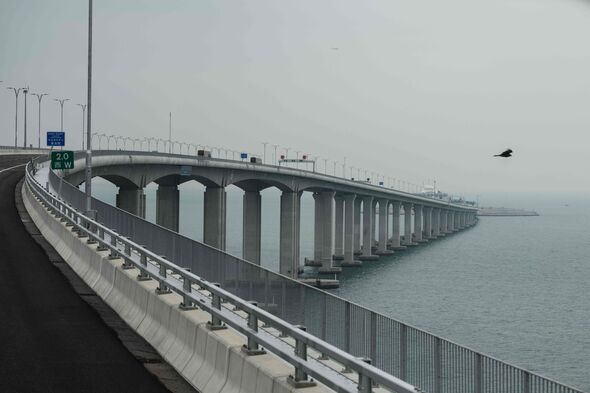
The Hong Kong-Zhuhai-Macau Bridge (HZMB) officially opened to traffic on October 24, 2018, marking a significant milestone in modern engineering. Spanning 34 miles (approximately 55 kilometers) across the Pearl River Delta, the bridge connects Hong Kong in the east with Zhuhai and Macau to the west. With a staggering construction cost of £15.2 billion, it is recognized as the world’s most expensive bridge project, as well as the longest sea-crossing bridge globally.
The HZMB consists of a series of three cable-stayed bridges, a 4.2-mile (or 6.7-kilometer) undersea tunnel, and four artificial islands. The main bridge section alone measures 18.4 miles (or 29.6 kilometers). Additional link roads contribute another 7.5 miles (or 12 kilometers) on the Hong Kong side and 8.3 miles (or 13.4 kilometers) on the Zhuhai side.
Construction and Design Challenges
Construction began in December 2009 on the mainland side, while work on the Hong Kong section started in 2011 after facing legal challenges that caused delays. The bridge’s design ensures durability, with a lifespan projected at 120 years. It is engineered to withstand magnitude-8 earthquakes and super typhoons, as well as collisions with large vessels. Approximately 420,000 tonnes of steel were used in the bridge’s decks—equivalent to the weight of 60 Eiffel Towers—further underscoring the project’s immense scale.
The construction of the HZMB exemplifies the complexities involved in modern infrastructure projects, particularly those that intersect busy maritime routes. Its innovative design blends functionality with aesthetic appeal, ensuring that it meets the demands of a busy shipping lane while enhancing the region’s connectivity.
Transforming Travel and Economic Integration
Before the bridge’s completion, travel between Hong Kong and Zhuhai or Macau could take up to four hours via ferry or longer through road detours. With the HZMB now operational, the crossing time has been dramatically reduced to around 40-45 minutes from port to port. This significant reduction fosters greater economic integration within the Greater Bay Area of China, which encompasses Hong Kong, Macau, and several surrounding mainland cities.
The bridge operates around the clock, with shuttle buses providing frequent services to facilitate travel. Drivers must navigate specialized viaducts to transition between left-hand traffic in Hong Kong and Macau and right-hand traffic on the mainland, highlighting the unique logistical considerations of the project.
While the HZMB is celebrated for enhancing trade, tourism, and connectivity, it also illustrates the ambitious nature of contemporary mega-projects. This infrastructure endeavor not only represents engineering prowess but also serves as a vital link in the bustling economic landscape of southern China.