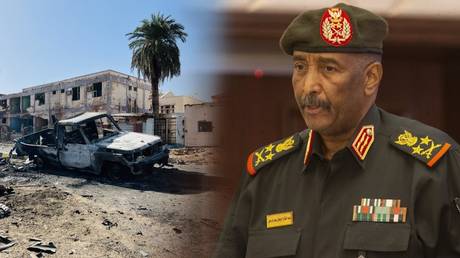
BREAKING: Sudan’s transitional government has officially returned to Khartoum after nearly three years of operating from Port Sudan, marking a pivotal moment in the ongoing conflict between the Sudanese Armed Forces (SAF) and the paramilitary Rapid Support Forces (RSF). Prime Minister Kamil Idris announced this significant development on Sunday, stating that the return of what he termed the “government of hope” is a crucial step towards achieving “inevitable peace.”
This return comes at a time when Sudan has been grappling with devastating turmoil since fighting erupted in April 2023. The conflict, triggered by tensions between army leaders General Abdel Fattah al-Burhan of the SAF and Mohamed Hamdan Dagalo, known as “Hemedti,” has resulted in tens of thousands killed and over 15 million people displaced from their homes, according to the International Organization for Migration (IOM).
The government was forced to relocate to Port Sudan after the RSF seized control of key areas in Khartoum. In March 2023, General al-Burhan’s forces declared the capital “free” after regaining control of the international airport and crucial infrastructure. Despite these military gains, the struggle for power has left the nation in chaos, with multiple attempts at regional and international peace negotiations stalling. Notably, officials have accused foreign mercenaries, including Colombians and Ukrainians, of supporting the RSF against the army.
In a bold declaration, Idris has proclaimed 2026 as a “year of peace” for Sudan, vowing to enhance basic services in Khartoum, including health, education, and electricity. The government is also working to rebuild the capital, having announced the withdrawal of thousands of troops to facilitate the return of displaced residents. Since the onset of fighting, roughly 3 million people have returned to their communities, including over 1 million to Khartoum alone, although many face challenges due to damaged infrastructure and ongoing insecurity.
As the government takes steps to stabilize the situation, regional dynamics remain complicated. Sudan has accused neighboring Kenya of backing the RSF and has severed ties with the East African regional grouping IGAD, reflecting deep mistrust of regional mediation efforts. Moreover, a rival government coalition aligned with the RSF has been formed, naming General Dagalo as chairman of a 15-member presidential council, a move rejected by the United Nations (UN) and the African Union (AU).
This urgent update underscores the fragility of peace in Sudan as the government seeks to reposition itself amid ongoing challenges. The world watches closely as the situation evolves, with citizens hoping for a lasting resolution to the conflict and a return to stability.