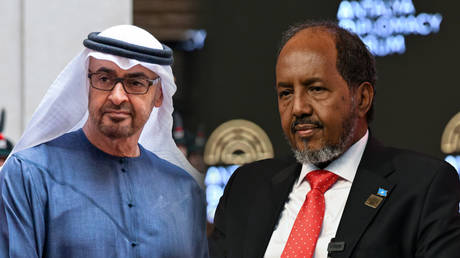
Somalia has officially terminated all agreements with the United Arab Emirates, including crucial port deals and defense cooperation, due to concerns over violations of its sovereignty. The Somali government cited actions by the UAE that allegedly undermine the independence of the East African nation. This significant decision was announced on Monday by the Council of Ministers, following a thorough review of recent developments.
Somali Defense Minister Ahmed Moallim Fiqi stated in a post on X that the government acted on “reliable reports and evidence pointing to practices” associated with the UAE. He emphasized that these actions constitute a clear breach of the principles of sovereignty and the respect for state independence, as well as non-interference in internal affairs.
Details of the Termination
The agreements that have been canceled include key partnerships involving the ports of Berbera, Bosaso, and Kismayo, along with various security and defense cooperation initiatives. Although Minister Fiqi did not specify the exact actions taken by the UAE that prompted this measure, the implications for bilateral relations are profound.
The termination of these agreements comes in the wake of investigations by Somalia’s immigration authority into the “unauthorized” use of Somali airspace and airports. This investigation is linked to the movement of Aidarus al-Zoubaidi, a political figure associated with Yemen’s Southern Transitional Council, who reportedly traveled to the UAE via Berbera on January 8. Somalia warned that if these reports are accurate, they could represent a serious violation of its sovereignty and existing bilateral arrangements.
Context and Reactions
The recent actions come just weeks after Israel became the first nation to formally recognize the independence of Somaliland, a self-declared region that broke away from Somalia in 1991. This recognition was met with significant criticism, as no other government had previously acknowledged Somaliland’s independence. Analysts suggest that the UAE may have influenced Israel’s decision to recognize Somaliland, despite the UAE’s public statements supporting Somalia’s territorial integrity.
As of now, the UAE has not issued a response to Somalia’s claims. The escalation of tensions highlights the fragile nature of international relations in the Horn of Africa, where strategic interests, economic partnerships, and national sovereignty frequently intersect.
This development marks a critical moment for Somalia’s foreign policy and its ongoing struggle to assert sovereignty in a region characterized by complex geopolitical dynamics. The future of Somali-UAE relations remains uncertain, with potential implications for regional stability and security cooperation.