BREAKING: In a landmark decision, Montenegro has officially revoked the prestigious Risto Ratkovic Award from war criminal Radovan Karadzic, marking a significant cultural shift. This urgent update comes as the award’s committee announced the removal of Karadzic’s name from its official list of laureates, a move that symbolizes a long-overdue correction of a controversial decision made during the war-torn 1990s.
The revocation, which took place on November 6, 2025, follows months of political initiatives and public outcry. The decision was propelled by a resolution from the local government of Bijelo Polje, dated October 2, 2025, aimed at addressing the legacy of a figure convicted of genocide and crimes against humanity.
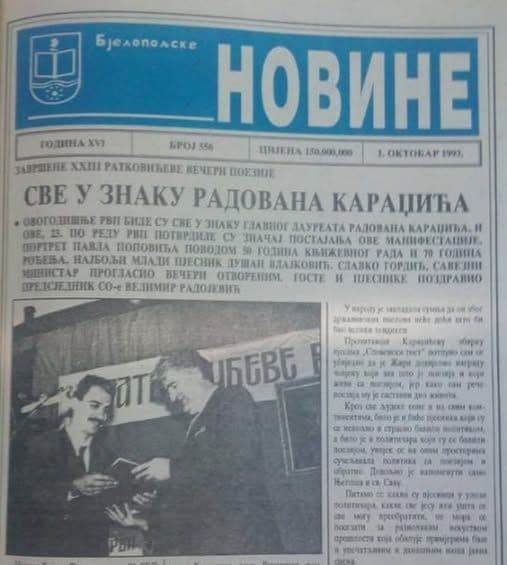
Officials confirmed that the decision to strip Karadzic of the award—originally bestowed upon him in 1993, just months after the horrific Srebrenica massacre—was unanimous. The award was given to Karadzic while he was serving as the president of the self-proclaimed Republic of Srpska, during a time marked by widespread atrocities against non-Serbs in Bosnia and Herzegovina.
This action comes as Montenegro grapples with its historical narrative and the implications of past decisions. A coalition of civil society organizations, including the Civic Initiative and the Bosniak Party, spearheaded calls for the revocation, emphasizing the need for accountability and recognition of the victims.
In an official statement, the Public Institution “Ratkovic Evenings of Poetry” noted, “The award given to Radovan Karadzic, who holds political and military responsibility for the crimes committed, has been rightfully revoked.” The decision was met with applause from activists who have long campaigned for justice and acknowledgment of the past atrocities.
The implications of this decision extend beyond cultural symbolism; it reflects a growing sentiment in Montenegro against the glorification of wartime figures. Demir Licina, representing the families of victims, remarked, “This isn’t just about a literary award; it’s about our stance towards the truth and the values we want to uphold as a community.”
Montenegro’s political landscape remains polarized, with factions debating the significance of acknowledging past crimes. The ruling coalition, including the Europe Now Movement led by Milojko Spajic, faced criticism for their opposition during the voting, highlighting the contentious nature of the decision.
This revocation comes after decades of silence surrounding the award, which had become a source of embarrassment for the nation, particularly in light of the international legal rulings confirming Karadzic’s role in orchestrating genocide. The decision to remove his name is described as a minimal yet crucial step towards institutional accountability.
As Montenegro moves forward, the focus will be on how this decision influences the discourse around war crimes and historical accountability in the region. The public response has been overwhelmingly supportive, indicating a shift in societal attitudes towards recognizing the truth of the past.
The Risto Ratkovic Award is now free from the shadow of Karadzic’s legacy, and Montenegro strives to redefine its cultural identity in a post-war context. This decision is seen as a vital acknowledgment of the pain endured by victims and their families, sending a clear message that the nation will not condone the glorification of war criminals.
Stay tuned for more updates as the situation continues to evolve.