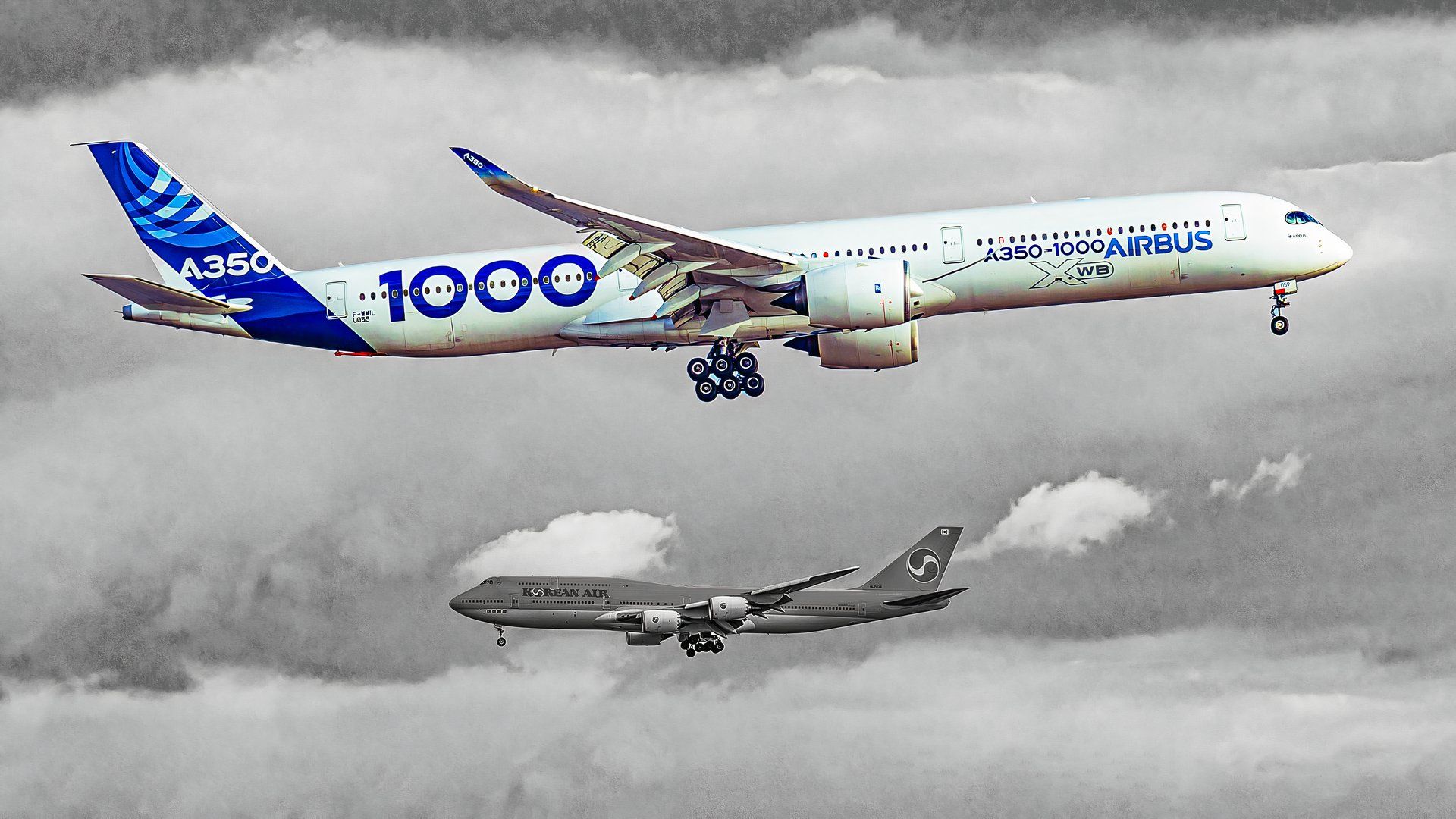
BREAKING: The aviation industry is buzzing with the latest insights into the size and efficiency battle between the Airbus A350-1000 and the iconic Boeing 747. As the A350-1000 emerges as the largest aircraft currently produced by Airbus, aviation experts are keenly analyzing how it stacks up against the legendary Boeing 747, particularly the 747-8 model, known for its remarkable history and substantial capacity.
Officials confirm that the Airbus A350-1000 measures 242 feet (73.78 meters) in length but is notably smaller than the Boeing 747-8, which stretches out to 250 feet, 2 inches (76.25 meters). Despite its impressive length, the A350-1000’s wingspan of 212 feet, 5 inches (64.75 meters) is comparable to the 747-400, yet its overall weight stands at 319 metric tons (MTOW), significantly lighter than the 747-8’s 447.7 tons.
Why does this matter? The growing preference for the A350-1000 highlights a pivotal shift in the aviation sector towards more fuel-efficient designs. Airlines are increasingly opting for twin-engine aircraft like the A350-1000, capable of longer ranges while consuming less fuel. Qantas, for instance, has selected a high-gross-weight variant of the A350-1000 for its ambitious “Project Sunrise,” aiming to connect Australia’s East Coast with London and New York nonstop.
The evolution of aircraft design has transformed the landscape of long-haul travel. While the Boeing 747 was a dominant force for decades, with over 1,500 units sold since its inception, the A350-1000 represents a new era of efficiency. This aircraft is not only designed for long-haul routes but also incorporates advanced carbon-composite materials which contribute to its reduced empty weight.
The differences extend beyond size. The A350-1000’s Rolls-Royce Trent XWB-97 engines are the most powerful ever fitted to an Airbus, generating 97,000 lbs of thrust, while the Boeing 747-200B’s Pratt & Whitney engines deliver 45,500 lbs. This stark contrast underscores the technological advancements made in aviation over the past years.
In terms of passenger capacity, the A350-1000 typically accommodates nine seats across in economy class, compared to the 747’s standard ten-abreast configuration. This difference is crucial for airlines when maximizing revenue on long-haul flights. However, the capacity difference is not as significant as one might expect, considering the A350-1000’s spacious interior design.
Looking ahead, the competition intensifies with the upcoming Boeing 777-9, designed to be the longest passenger aircraft at 251 feet, 9 inches (76.72 meters). The 777-9 will feature a larger wingspan, pushing the envelope in terms of capacity and efficiency, and intensifying the challenge for both the A350-1000 and the 747.
The latest data shows that the A350-1000 has garnered over 362 orders, positioning it as a formidable contender in the widebody aircraft market. Meanwhile, the Boeing 777-300ER, which effectively replaced the 747 in many airline fleets, continues to see substantial interest due to its modern design and operational efficiency.
As the aviation industry rapidly evolves, the Airbus A350-1000 and Boeing 747-8 represent two distinct philosophies in aircraft design—one prioritizing efficiency and modernity, the other rooted in a rich legacy of air travel. The race is on to see which aircraft will dominate the skies of tomorrow.
Stay tuned for further updates on this exciting aviation showdown that is reshaping how we think about long-haul travel!