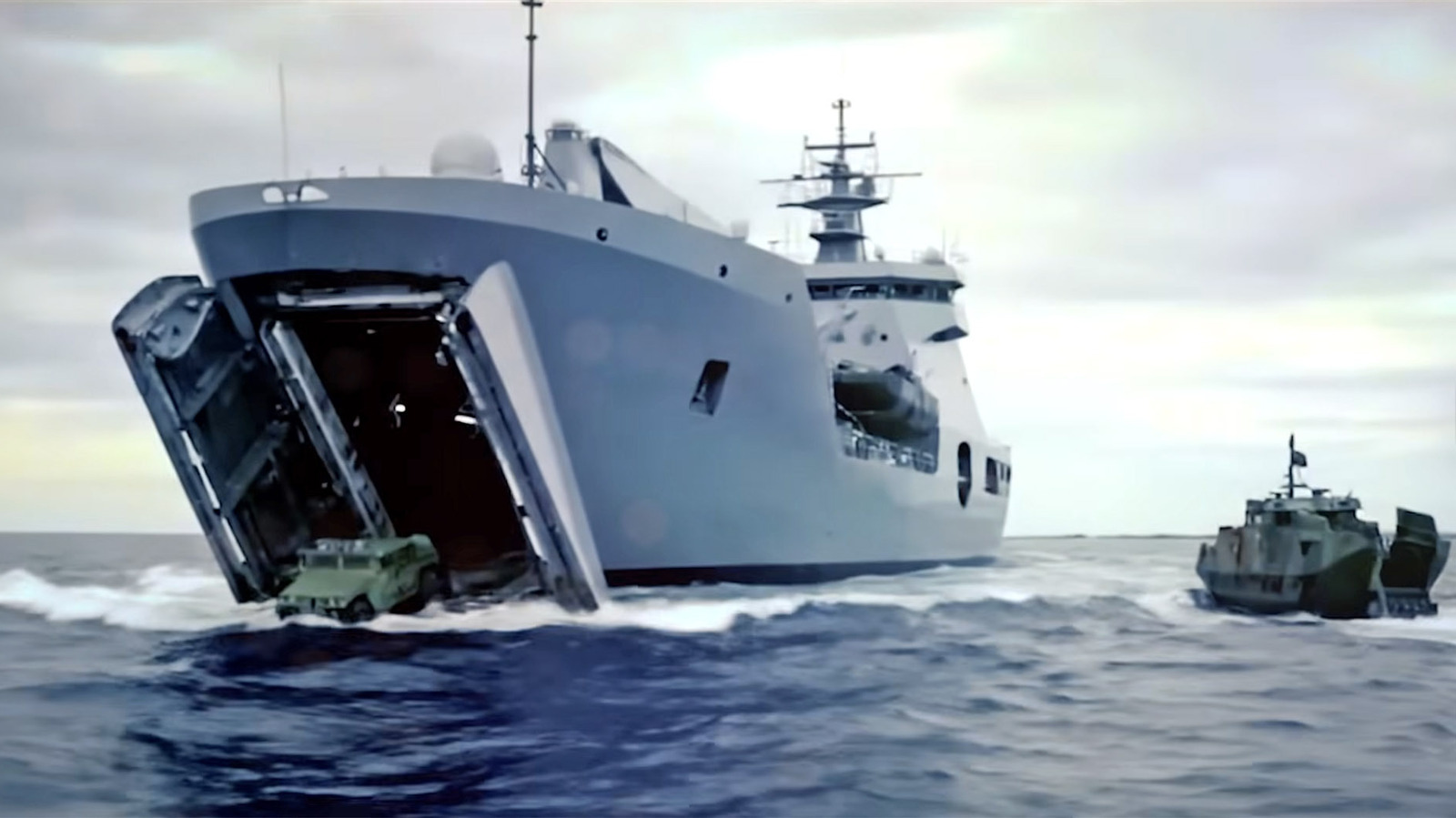
The United States Navy has selected a foreign design for its new medium landing ship, the LST-100, developed by Dutch company Damen. This decision, announced in December 2025, marks a significant step in modernizing the Navy’s fleet amid ongoing changes to its maritime capabilities. The LST-100 is set to enhance the Navy’s operational efficiency by providing a proven design that can be built more rapidly than a prototype vessel.
The LST-100 is categorized as a landing ship medium (LSM) and is specifically designed for expedient deployment of U.S. Marine Corps forces directly onto shore without requiring a port or harbor. Equipped with a rear loading ramp and clamshell doors at the bow, each ship can transport more than 230 soldiers along with their vehicles. When completed, the vessel will weigh approximately 4,000 tons and possess a range of around 3,400 nautical miles, making it well-suited for various operational scenarios.
The U.S. Navy plans to construct the LST-100 ships domestically, despite the design originating from abroad. This approach aims to streamline the production process while adhering to the Navy’s requirement for quick deployment. Each ship will feature a helipad on the stern, allowing for the deployment of helicopters or drones, further enhancing its versatility.
The selection of the LST-100 comes as the U.S. Navy grapples with significant delays and rising costs in its shipbuilding projects. Recent challenges, including supply chain disruptions, have affected timelines for various vessels, including the forthcoming aircraft carrier USS Enterprise. By opting for Damen’s established design, the Navy aims to mitigate these issues and expedite the introduction of new landing ships into service.
In collaboration with the U.S. Marine Corps, the Navy played a crucial role in the design selection process, ensuring that the new ships meet operational needs. While the LST-100 will primarily support Marine Corps missions, its construction aligns with broader naval strategies, especially concerning potential conflicts in the Indo-Pacific region.
The construction of the first LST-100 is scheduled to commence in 2026, with an ambitious delivery target set for 2029. Ultimately, the Navy and Marine Corps hope to integrate at least 35 of these new landing ships into their fleet. This initiative reflects a proactive approach to ensuring the U.S. military remains capable of responding effectively to emerging threats and challenges.
As the Navy moves forward with this project, the focus will not only be on the performance of the LST-100 but also on the efficiency of its construction. The aim is to replace long-standing delays with a streamlined process that can adapt to evolving military needs. The successful implementation of the LST-100 will represent a significant milestone in the ongoing modernization of the U.S. Navy’s capabilities, reinforcing its readiness for future operations.