Researchers have identified the source of three enigmatic signals emanating from the heart of the Milky Way, attributing them to a specific type of dark matter known as ‘excited dark matter’. This breakthrough sheds light on previously unexplained phenomena in our galaxy, which has long puzzled astronomers.
Unraveling the Mystery of Gamma-Ray Signals
The heart of the Milky Way is home to a supermassive black hole, Sagittarius A*, which possesses a mass approximately four million times that of the Sun. This region is characterized by extreme gravitational forces that create an environment where dense gas clouds are rapidly transformed into stars. Yet, amidst this chaos, scientists have detected a sharp spike in gamma-ray radiation at a specific wavelength known as the 511-keV emission line.
Dr. Shyam Balaji, the lead author of the study from King’s College London, explained that conventional astrophysical events, such as star explosions, cannot fully account for the unique energy and shape of the signals observed. Their research, published in The Astrophysical Journal Letters, suggests that excited dark matter could explain at least two, if not all three, of these mysterious signals.
Dark matter comprises roughly 27 percent of the universe but remains invisible and undetectable through ordinary means. Its presence is inferred from gravitational effects on visible matter, and the new findings suggest that it plays a crucial role in the behavior of the Milky Way’s core.
How Excited Dark Matter Works
According to Dr. Balaji, excited dark matter is characterized by particles that can briefly transition into a higher energy state when they collide. Upon returning to their normal state, they release energy by creating an electron and its antimatter counterpart, a positron. These positrons generate signals detectable by advanced telescopes, such as the European Space Agency’s INTEGRAL mission, which orbits at an altitude of 60,000 km.
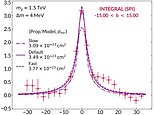
By analyzing data from INTEGRAL, researchers compared it against models predicting how positrons might behave in space. The collisions between positrons produced by excited dark matter could result in a gamma-ray spike corresponding to the elusive 511-keV line.
In their ongoing investigation, the scientists discovered that their model could also account for the 2 MeV gamma-ray continuum, a high-energy light observed in the same region. Dr. Balaji noted that this signal requires positrons with very specific energy levels, a range that conventional astrophysical sources struggle to produce.
Furthermore, the researchers propose that excited dark matter might explain the high levels of ionization observed in an area known as the Central Molecular Zone (CMZ), located around 28,000 light-years from Earth. This zone contains a significant portion of the galaxy’s dense gas, yet traditional sources like cosmic rays have failed to clarify the observed ionization levels.
Co-author Damon Cleaver, a PhD student at King’s College London, emphasized the importance of their findings, stating, “If one mechanism could account for several long-standing unexplained observations in space, it gives a much clearer direction for future research.”
As the scientific community prepares for the next generation of space missions, there is hope that further exploration could validate the role of dark matter in resolving some of the Milky Way’s enduring mysteries and enhance our understanding of this elusive substance.
Dark matter, though still largely theoretical, is considered to be the gravitational ‘glue’ that stabilizes galaxies. Estimates suggest that it constitutes around 85 percent of the universe, highlighting its significance in cosmological studies. While astronomers have not yet directly observed dark matter, its gravitational influence is evident, underscoring the necessity for continued exploration in this captivating field of study.