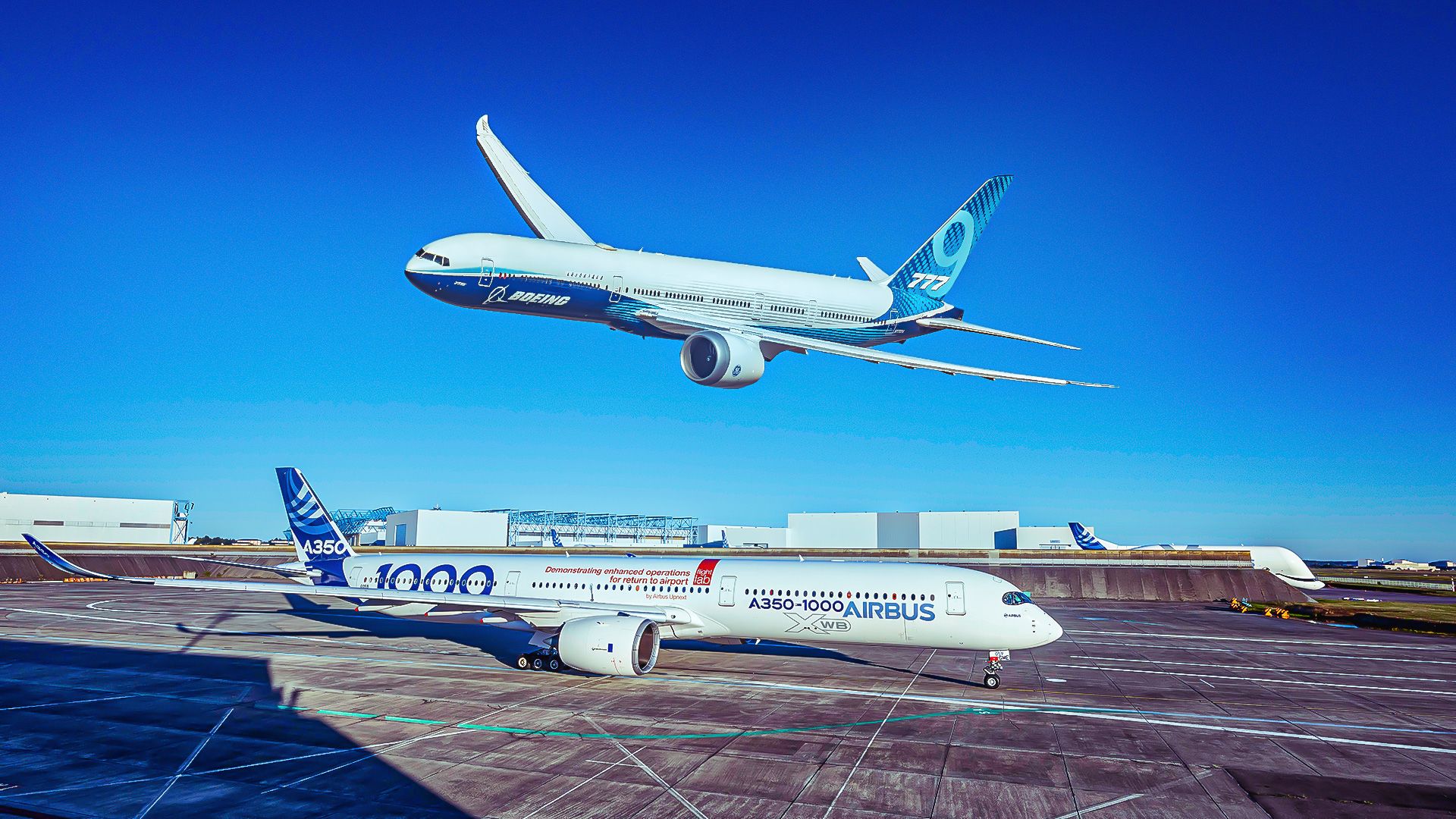
The competition in the long-haul aviation sector is intensifying as the Boeing 777X family takes on the Airbus A350-1000. Airlines are increasingly focused on the range of these aircraft, which influences operational efficiency and profitability across global networks. The stakes are high, with both aircraft positioned as the next-generation flagships for their respective manufacturers, expected to serve long-haul fleets well into the 2040s.
While the Boeing 777-8 boasts a maximum range of up to 8,745 nautical miles (16,196 kilometers), the Airbus A350-1000 is advertised with a slightly longer range of approximately 9,000 nautical miles (16,668 kilometers). This brings both aircraft remarkably close in their theoretical capabilities. In contrast, the larger Boeing 777-9 is optimized for capacity rather than maximum distance, offering a range of about 7,285 nautical miles (13,492 kilometers).
Comparative Analysis of Range and Design
The Airbus A350-1000 occupies a unique position in the widebody market. It provides additional passenger capacity and a longer range than the 777-9, making it appealing for airlines that require a balance of long-haul capability and seat count. However, the upcoming Airbus A350-1000ULR (Ultra Long Range) variant, designed for Qantas’s Project Sunrise, could shift this balance. Set to fly up to 9,700 nautical miles (17,964 kilometers) and enable nonstop flights of up to 22 hours, this model challenges both the 777-8 and the 777-9 on extreme long-haul missions.
Several design factors contribute to the range differences between these aircraft. The Boeing 777-9, the largest variant, stretches 251 feet and 9 inches (76.7 meters) in length, allowing for a two-class capacity of around 426 seats. In comparison, the Airbus A350-1000 measures approximately 241 feet (73.8 meters) and typically accommodates between 350 to 370 seats.
The wing design also plays a crucial role in performance. The 777X features the largest composite wing on a commercial aircraft, measuring 235 feet and 5 inches (71.8 meters). This wing enhances aerodynamic efficiency and optimizes fuel burn over long distances. The Airbus A350-1000 benefits from a lighter airframe, constructed with carbon-fiber-reinforced plastic, which helps maintain long range while supporting a relatively high passenger capacity. Combined with its efficient Rolls-Royce Trent XWB engines, the A350-1000 serves long-haul routes effectively where range is critical.
Airlines’ Strategic Choices and Market Positioning
Airlines select the Boeing 777X and Airbus A350-1000 based on their specific operational needs. Emirates, the largest customer for the 777X program, has committed to a significant number of 777-9s, primarily as replacements for the Airbus A380 on select routes. This decision aligns with Emirates’ hub-and-spoke model, focusing on transporting high volumes of passengers between major hubs.
Conversely, airlines like Qatar Airways are leveraging both aircraft types to create a complementary fleet. Qatar extensively operates the A350-1000 and has placed orders for the 777-8, reflecting a strategy that capitalizes on range flexibility. The A350-1000 has already been deployed on some of the longest commercial routes, such as Doha to Auckland, which frequently exceeds 15 hours in the air.
Cathay Pacific’s fleet strategy further highlights the versatility of the A350-1000. While continuing to operate the Boeing 777-300ER, the A350-1000 increasingly undertakes missions that require both long range and substantial payload capacity. This adaptability positions the A350-1000 as a suitable successor to the 777-300ER in certain markets, where airlines may not always be able to fill a larger aircraft.
Looking beyond these two flagship models, other long-haul widebodies also play a role in the market. Notably, the Airbus A350-900 offers slightly more range than the A350-1000, albeit with fewer seats. Boeing’s 787-9 and 787-10 also address different segments of long-haul travel by trading off capacity for range and efficiency.
The 777X family, with its two distinct variants, caters to a broader range of missions compared to the A350-1000 alone. The 777-8 competes with the longest-range aircraft ever built, while the 777-9 targets high-capacity needs similar to the A380 but with improved fuel efficiency.
As the aviation industry anticipates the 777X’s entry into commercial service, key risks remain. Certification delays have postponed its operational debut, meaning concrete performance data is still pending. The A350-1000, on the other hand, has flown commercially for several years, providing a benchmark for operational capability.
Airport compatibility also poses a challenge for the 777X, particularly with its folding wingtips, which may introduce operational complexities. Restrictions on wingtip operations could affect gate availability and overall dispatch reliability.
The A350-1000ULR variant, specifically configured for ultra-long-haul missions, targets routes like nonstop services from Australia to London and New York. Its design prioritizes passenger comfort and extended range, carrying approximately 238 seats in Qantas’s layout.
As airlines navigate regulatory and environmental pressures, the emphasis on efficiency may outpace the importance of raw range. The A350-1000’s lighter structure could prove advantageous as emission standards become more stringent.
In conclusion, while the Boeing 777-8 technically holds a slight advantage in range over the A350-1000, the broader picture is more complex. Airlines will ultimately choose based on their specific mission profiles. Those requiring ultra-long-haul capabilities with moderate capacity may find the A350-1000ULR particularly appealing, whereas airlines focused on maximizing passenger numbers on major routes might prefer the capacity of the 777-9. The full impact of these choices will become clearer once the 777X enters service, allowing for a comparison of promised performance against real-world operational outcomes.