Researchers at the University of Konstanz have introduced a pioneering contact-free method for removing liquids from delicate microstructures. This innovative technique employs vapor condensation to create surface currents that effectively transport droplets away from microscopic surfaces, a significant advancement for various technologies reliant on micro-elements.
The new method, detailed in the journal Proceedings of the National Academy of Sciences, addresses a critical challenge faced during the manufacturing of microchips and other similar components. These processes often require surfaces to be coated with various liquids, which must be meticulously removed to ensure the integrity of the final products.
Harnessing Surface Tension for Liquid Removal
Led by physicist Stefan Karpitschka, the research team capitalized on the natural phenomenon of surface tension to facilitate the efficient removal of liquids. Every liquid possesses a unique surface tension, which can be harnessed to manipulate their movement. For instance, water’s surface tension allows insects like the water strider to glide effortlessly, while this very property complicates the cleaning of micro and nanoscale structures.
Karpitschka explained the intricate steps involved in microchip fabrication, noting, “To transform thin silicon disks, known as silicon wafers, into microchips, several processes require wet treatment, including the etching of transistors in acid baths.” Traditional methods of cleaning, such as wiping or boiling off residues, risk leaving contaminants on these sensitive materials.
Innovative Approach to Fluid Dynamics
To overcome these challenges, Karpitschka and his team developed a method that minimizes contact with the fragile surfaces. This approach utilizes the Marangoni force, which is driven by differences in surface tension. When two adjacent areas of a surface exhibit varying levels of tension, a current is generated, effectively pulling the liquid in a desired direction.
In their experiments, the researchers employed evaporated alcohol, which has a lower surface tension than water. As the alcohol vapor condenses on the wet surface, it creates the necessary differential tension to drive the liquid droplets away. Karpitschka described this process, stating, “We guide the resulting currents across the entire surface to coalesce the remaining liquid into larger droplets.”
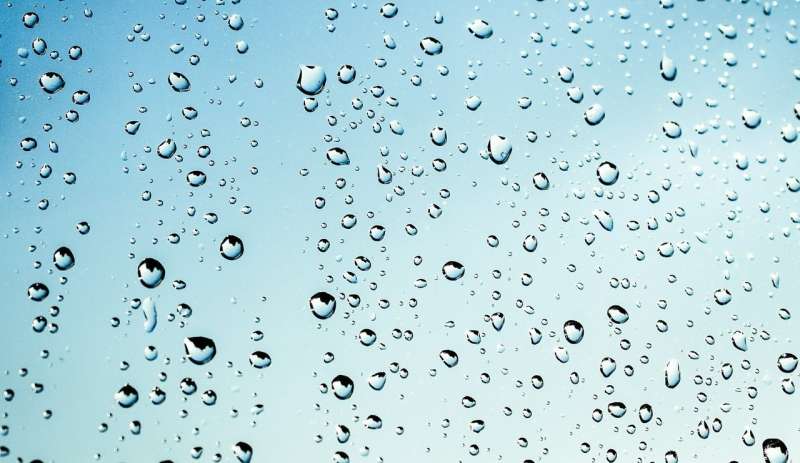
The outcome mimics the natural phenomenon of raindrops merging on a windowpane, but in this scenario, the researchers skillfully direct the path of the droplets. This method not only enhances the efficiency of drying small structures but also protects them from damage, paving the way for more effective production of micro- and nanomaterials.
The implications of this research extend across numerous industries, particularly those that utilize micropatterned surfaces. By refining the way liquids are removed, this contact-free technique promises to improve manufacturing processes and product quality in the increasingly important field of microtechnology.