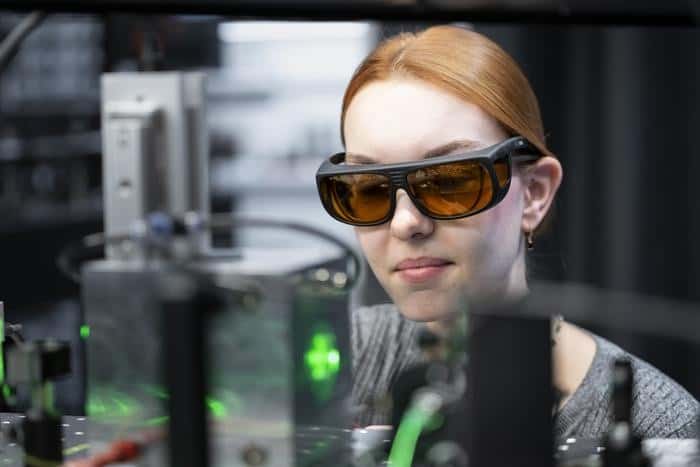
An international research team has developed a technique to precisely control the electrical charge on objects held in optical tweezers, a method that could enhance understanding of atmospheric phenomena such as aerosols and clouds. Led by Scott Waitukaitis from the Institute of Science and Technology Austria, this innovation builds on an effect first observed by Nobel laureate Arthur Ashkin in the 1970s.
Optical tweezers utilize focused laser beams to trap and manipulate tiny objects ranging from approximately 100 nanometers to 1 micron in size. These tools have become essential in various fields, from quantum optics to biochemistry. In 2018, Ashkin was awarded the Nobel Prize for his contributions to the invention of optical tweezers, which include the ability to charge trapped objects with laser light. Although Ashkin’s findings were groundbreaking, they received little attention at the time and remained largely overlooked.
Waitukaitis’ team rediscovered this phenomenon while investigating how electrical charges accumulate in ice crystals within clouds. In their experiments, they used micron-sized silica spheres to represent ice crystals but found that Ashkin’s charging effect interfered with their observations. “Our goal has always been to study charged particles in air in the context of atmospheric physics – in lightning initiation or aerosols, for example,” Waitukaitis noted. Initially disappointed by the unexpected charging, the team soon realized they might have stumbled upon a significant phenomenon.
To explore this effect further, the researchers modified their optical tweezers setup. They incorporated two copper lens holders that served as electrodes, enabling them to apply an electric field along the axis of the opposing laser beams. If the silica sphere became charged, the electric field would induce vibrations, causing some of the laser light to scatter back toward each lens. This scattered light was captured using a beam splitter and directed to a photodiode, allowing for real-time tracking of the sphere’s position.
The innovative approach enabled the team to convert the amplitude of the vibrating particle into a charge measurement. Their findings confirmed Ashkin’s hypothesis from 1976 that electrons on optically trapped objects can escape through a nonlinear two-photon absorption process, leading to a positive charge on the object.
The research team enhanced this model further, demonstrating that the charge on a trapped object can be precisely controlled by adjusting the laser’s intensity. This capability has proven beneficial for their original research objectives, particularly in studying charged aerosols. “We can get [an object] so charged that it shoots off little ‘microdischarges’ from its surface due to breakdown of the air around it, involving just a few or tens of electron charges at a time,” Waitukaitis explained. “This is going to be really cool for studying electrostatic phenomena in the context of particles in the atmosphere.”
These groundbreaking findings are detailed in a paper published in Physical Review Letters. The implications of this research extend beyond academic interest, potentially informing future studies of climate and atmospheric dynamics. As scientists continue to unravel the complexities of atmospheric science, this controlled charging technique may open new avenues for research on how particles interact in the air, particularly in relation to weather phenomena.