The interstellar object known as 3I/ATLAS has undergone a dramatic transformation following its close approach to the Sun. Rather than simply surviving the encounter, the object has begun emitting a toxic mix of gases, marking a significant departure from typical comet behavior. Observations from advanced space observatories reveal that the heat from this perihelion event triggered a chaotic change, resulting in the release of hazardous substances into space.
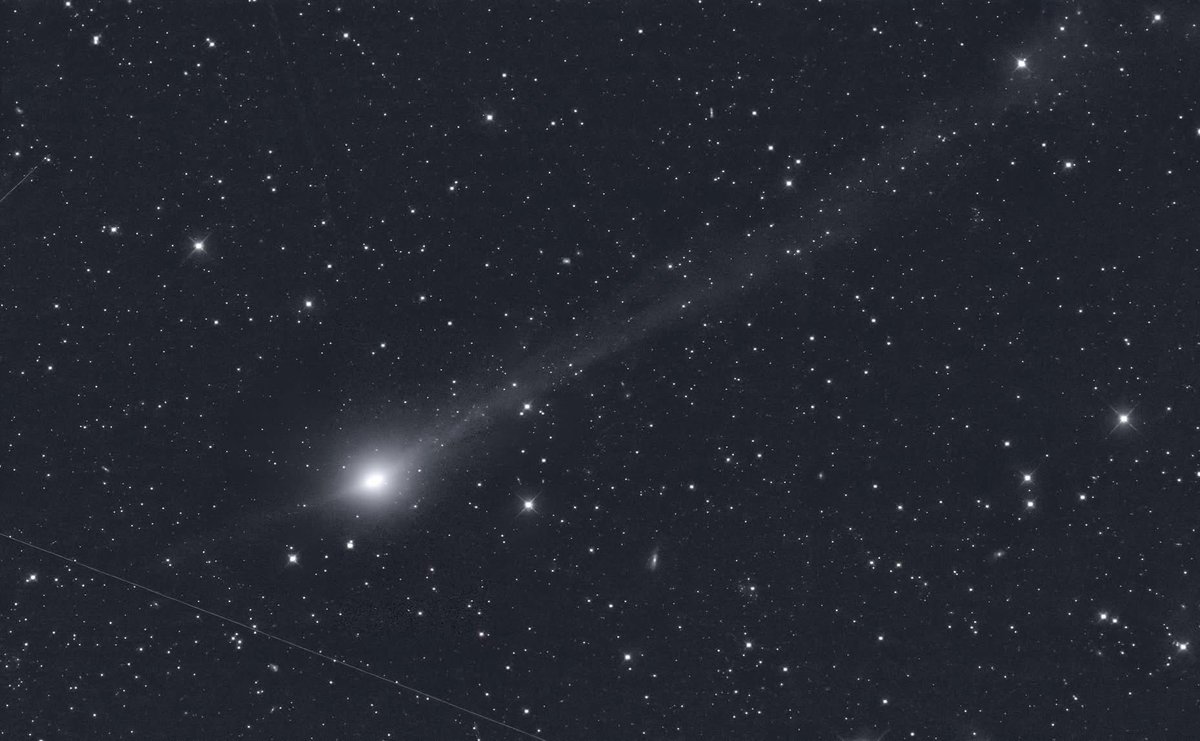
Data collected from the SPHEREx space observatory between December 8 and December 15, 2025, offers a detailed glimpse into this transformation. Infrared imaging spanning wavelengths from 0.75 to 5.0 microns revealed a distinct pear-shaped distribution of dust and organic material. This shape, complete with an “anti-tail” extending towards the Sun, contrasts sharply with the nearly round gas plumes identified in the same observations.
Among the chemicals detected were cyanide at 0.93 microns and carbon monoxide at 4.7–4.8 microns, contributing to a hazardous envelope surrounding the nucleus of 3I/ATLAS. The data also indicated significant emissions of water, organics, and carbon dioxide. The carbon dioxide plume is particularly noteworthy, extending hundreds of thousands of kilometres into space.
The analysis of the dust spectrum suggests a complex mix of scattered sunlight and thermal emissions. When comparing this recent data with earlier observations, the changes are striking. In August 2025, notable water-ice absorption features were present, but these have since disappeared. According to a post on January 16, 2026, by Harvard professor Avi Loeb, the spectrum now prominently features organo-silicaceous dust grains rather than ice.
The increase in water gas production has been substantial, surging approximately twenty times compared to levels recorded prior to the object’s perihelion. This spike in water emission appears to have brought other materials along with it, as spectral features for previously undetected cyanide and organics emerged post-encounter. A notable absence of fine dust particles is consistent with the observed behavior of 3I/ATLAS, suggesting a lack of a typical cometary tail driven by radiation pressure.
Research led by Carey Lisse indicates that 3I/ATLAS is losing mass at an alarming rate, approximately 180 kilograms per second, largely in the form of water. This rate parallels the loss of carbon dioxide and constitutes about two-thirds of the carbon monoxide loss rate. Brightness maps illustrate that the sources of these emissions vary, with cyanide and organic materials appearing to originate from the dust itself. In contrast, gases such as water, carbon dioxide, and carbon monoxide are released from a symmetric region centred on the nucleus.
The symmetry of gas release, combined with the expansive carbon dioxide plume, suggests an underlying internal process driving these emissions. To further investigate, the Hubble Space Telescope captured a series of images on January 14, 2026, revealing a glowing halo extending over 130,000 kilometres towards the Sun. Within this structure, processed images highlighted a sunward-directed anti-tail alongside three evenly spaced mini-jets.
Research co-authored by Loeb and fellow scientist Toni Scarmato indicates that the orientation of this jet system exhibits a wobble with a period of 7.1 hours. These findings, along with the recent data, challenge traditional cometary models regarding composition and structure, suggesting that 3I/ATLAS is not merely a standard comet but rather a highly active and dynamic celestial body.
As astronomers continue to study this remarkable object, the implications of its transformation and the potential hazards posed by its emissions remain an area of keen interest within the scientific community. The evolution of 3I/ATLAS serves as a reminder of the unpredictable nature of interstellar phenomena and the complexities involved in understanding them.