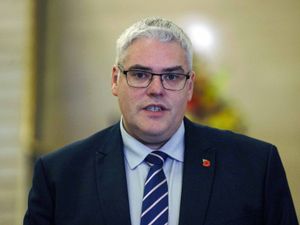
Gavin Robinson, leader of the Democratic Unionist Party (DUP), has expressed strong criticism towards Helen McEntee, the Irish Foreign Minister, regarding her recent comments on the Northern Ireland Legacy Bill. During a visit to Parliament Buildings in Belfast, McEntee stated that any significant amendments to the legislation must receive mutual agreement from both the UK and Irish governments. Robinson’s remarks come as the UK government continues to develop the Bill aimed at addressing the legacy of the Northern Ireland Troubles.
Robinson urged Prime Minister Sir Keir Starmer to resist what he termed as “spinelessly surrendering” to the pressures from the Irish Republic. The DUP leader’s comments highlight a growing tension over the proposed legislation, which aims to provide new protections for military veterans involved in the Troubles. Starmer has indicated that such protections will be incorporated into the Bill currently being reviewed in Parliament.
Legislative Background and Framework
In September 2023, a joint framework on legacy was announced by London and Dublin. This framework outlined various measures for addressing historical cases stemming from the Northern Ireland conflict. Among the proposed reforms is a significant overhaul of the structures established by the previous Conservative government’s contentious Legacy Act. This includes the removal of a controversial provision that offered conditional immunity to those involved in Troubles-related crimes.
Alongside this framework, the Labour Government unveiled proposals aimed at enhancing protections for Northern Ireland veterans. These measures include provisions that allow witnesses participating in new legacy processes to provide evidence remotely, thus avoiding the need to travel to Northern Ireland.
McEntee emphasized the delicate balance achieved in the September agreement, stating, “We are very clear as a government that in transposing that agreement and putting it into legislation, there cannot be any significant changes that shift that balance.” Her comments underscore the importance of cooperation between the two governments as they navigate this complex legislative landscape.
Robinson, in a communication to DUP members, reiterated the necessity for the legislation to protect veterans adequately. He commended military veterans for “putting their lives on the line to protect others and uphold the rule of law,” asserting that they deserve respect rather than the threat of legal repercussions decades later. He articulated the moral imperative to distinguish between those who upheld the law and those who engaged in acts of terrorism and violence.
Political Implications and Future Steps
The DUP leader’s criticism extends beyond the legacy legislation; he also took aim at John O’Dowd, the Stormont Finance Minister, for publishing a draft budget without the agreement of the Executive. Robinson described this budget as unsettled and raised concerns over its priorities, particularly in relation to public services and education.
“While we recognize the real financial pressures facing Northern Ireland, the priorities John O’Dowd has chosen raise serious concerns,” Robinson remarked. He pointed out that significant changes to the budget would be necessary to secure DUP support.
The overarching challenge for the UK government remains the balance between addressing the past and ensuring the future stability of Northern Ireland. As discussions progress, it remains to be seen how the proposed amendments will be received by both sides and what impact they will have on the ongoing reconciliation process in the region.