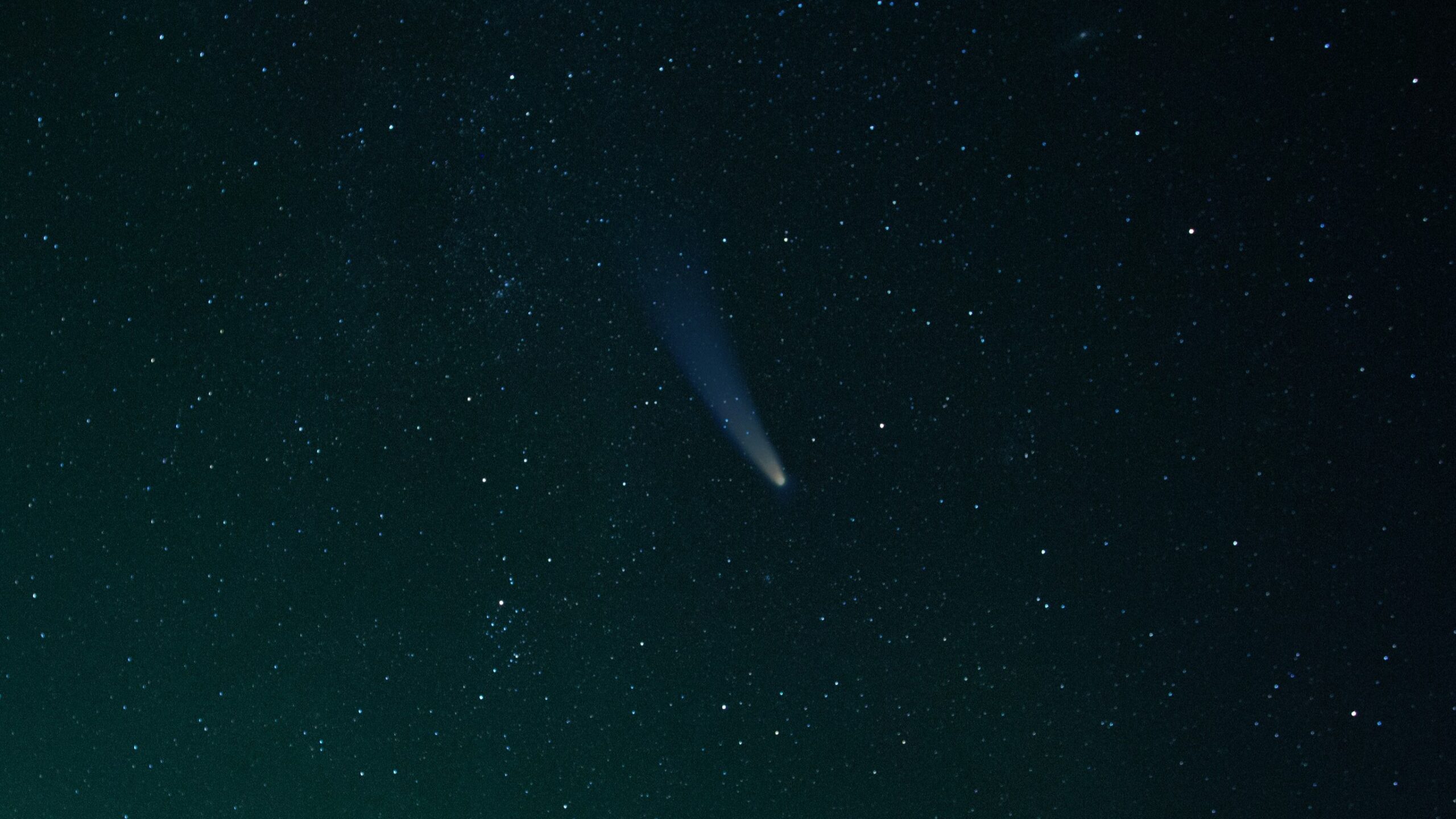
Astronomers have made significant discoveries about the interstellar comet 3I/ATLAS, revealing details about its composition that challenge existing knowledge about celestial bodies from beyond our solar system. This comet, which is only the second confirmed object to enter our solar system from interstellar space, exhibits characteristics that indicate it may be a “pristine” remnant from its formation billions of years ago.
Research conducted through detailed photometric observations has revealed that 3I/ATLAS possesses a high tensile strength and a notable amount of metal. By examining the light reflected from the comet as it approaches its closest point to the Sun, scientists have compared its brightness and spectral signatures to those of carbonaceous chondrites, a type of ancient meteorite housed in the NASA Antarctic collection. The findings suggest that 3I/ATLAS is enriched with native metals, a feature that sets it apart from similar celestial objects.
Cometary Behavior and Unique Chemical Processes
As 3I/ATLAS nears the Sun, it is undergoing significant changes due to the influence of water and possible cryovolcanism. This behavior aligns with expectations for a Trans-Neptunian Object (TNO), providing insights into the physical and chemical processes of such bodies. The presence of metals plays an active role in shaping the comet’s behavior, as fine-grained metal particles can trigger energetic Fischer-Tropsch reactions. These reactions, akin to those used for synthetic fuel production on Earth, generate chemical products that are seldom observed in typical solar system comets. Most comets originate from the outer solar system, where they do not inherit significant metal fractions.
The detection of cyanide radicals (CN) around 3I/ATLAS confirms that its nucleus contains typical cometary volatiles, similar to those found in local comets. CN is a by-product formed from the photodissociation of hydrogen cyanide (HCN), a molecule linked to organic chemistry pathways. Its presence indicates that 3I/ATLAS likely formed in the cold outer regions of its home star system, where nitrogen-rich ice can condense and remain intact for billions of years.
Moreover, spectroscopic observations have revealed nickel-bearing species within the comet’s coma, akin to findings from the earlier interstellar comet 2I/Borisov. The volatilization of nickel at low temperatures suggests that 3I/ATLAS formed in a metal-rich protoplanetary disk, where silicate and metallic grains were directly incorporated into its icy nucleus.
Carbon Chain Depletion and Interstellar Origins
One striking aspect of 3I/ATLAS is its apparent depletion of carbon-chain molecules, particularly C2 and C3. This chemical signature matches observations from 2I/Borisov and several carbon-depleted comets from our solar system. The depletion raises intriguing questions about the comet’s formation environment; it could either indicate a region deficient in carbon-chain organics or result from long-term exposure to interstellar radiation processing, which can chemically alter or destroy complex organic compounds.
Comets traversing interstellar space are subject to cosmic rays for millions of years, leading to the breakdown of long organic chains. The low levels of C2 and C3 in 3I/ATLAS suggest that it has spent extensive periods far from any star, in the vastness of interstellar space.
The chemical composition of 3I/ATLAS aligns with findings from 2I/Borisov, particularly regarding the presence of nickel-bearing volatiles, CN production, and carbon-chain depletion. This correlation suggests that interstellar comets may share similarities in their chemical processing histories or may originate from analogous regions in extrasolar systems, where ices accumulate alongside dust enriched with metals.
In summary, the analysis of 3I/ATLAS not only enhances our understanding of this specific comet but also provides valuable insights into the origins and evolution of celestial bodies from interstellar space. As research continues, astronomers hope to unlock further secrets about the universe’s distant and mysterious past.