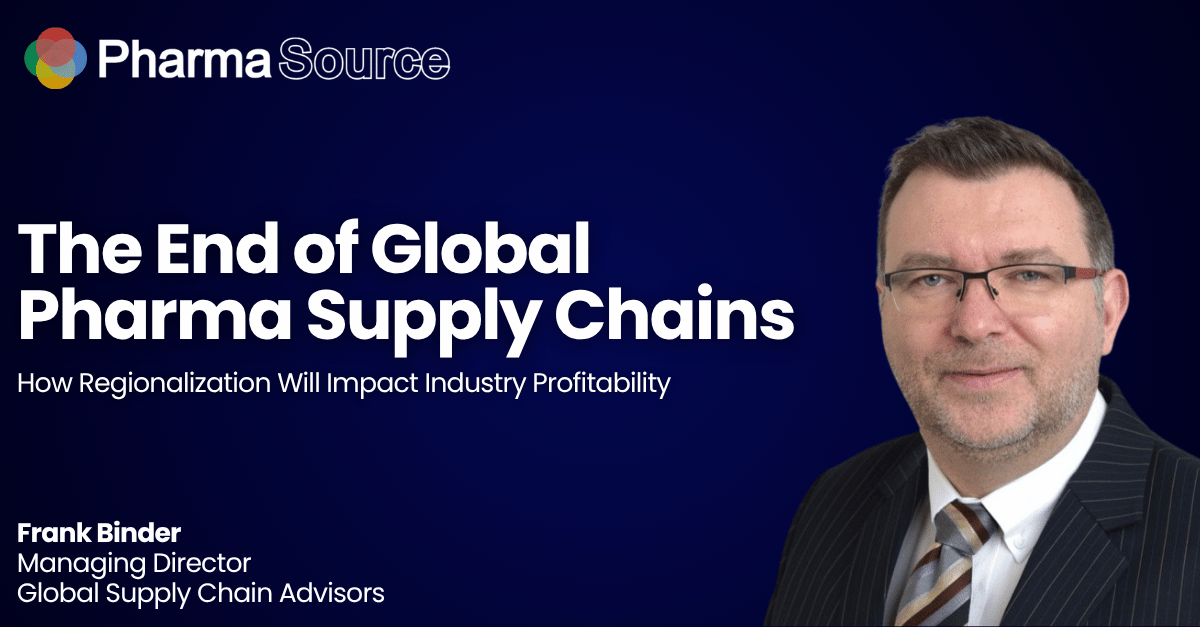
The pharmaceutical industry is facing a significant transformation as regionalization takes precedence over global supply chains, which is expected to impact profitability for decades. According to Frank Binder, Managing Director at GSCA (Global Supply Chain Advisors), the combination of recent US tariff announcements and increasing regulatory complexities has triggered a fundamental shift in how pharmaceutical companies operate.
In a recent episode of the PharmaSource podcast, Binder emphasized that waiting for clarity regarding these changes is no longer a viable strategy. Companies must act swiftly to adapt to a new era characterized by heightened uncertainty and complexity in supply chain management.
The Tariff Landscape and Its Implications
The United States, while accounting for over 10% of global trade across various industries, presents a unique scenario in pharmaceuticals. The recent announcement of a 100% tariff on certain pharmaceutical products has particularly unsettled the sector, according to Binder. “Even though the US makes about 10% of all trades globally, for pharmaceuticals it’s very different. The US as a market is still number one in the world,” he stated.
Although many tariff threats have been suspended in favor of company-specific price negotiations, the ongoing uncertainty surrounding tariffs and pricing has stifled decision-making across the industry. This situation has led to immediate disruptions in shipping patterns, with numerous European and Swiss companies rushing to relocate finished products to the US ahead of the tariff implementation.
Challenges in Import Compliance and Investment Decisions
The intricacies of import compliance have become increasingly complicated. Binder pointed out that the rules governing imports have multiplied, and clarity has diminished. “When I talk to my colleagues who are engaged in trade compliance in the US, it has become much more complex to import products,” he noted. Companies uncertain about their import compliance are advised to seek expert assistance without delay.
Despite announcements of over $400 billion in US manufacturing investments, Binder expresses skepticism regarding the realization of these commitments. He believes that while companies may be positioning themselves favorably in the eyes of the US government, the challenge lies in making sound investment decisions amid such volatility. “It’s impossible to continue a wait-and-see approach,” he cautioned, adding that the current situation represents a new set of rules that will endure for years, if not decades.
Even genuine commitments to reshoring face practical challenges. Investments are likely to concentrate in established pharmaceutical clusters such as Research Triangle Park, Boston, and San Diego, intensifying competition for construction workers and specialized equipment. This competition will further drive up construction costs, exacerbated by tariffs on essential building materials.
Shifting to a Regional Supply Chain Model
Binder anticipates a marked shift toward regionalization in supply chains, although this strategy will not be uniformly applied across all products. He believes that while some active pharmaceutical ingredients (APIs) and drug products will continue to be sourced globally, many companies will focus on dual sourcing for their top revenue-generating drugs that are particularly vulnerable to tariffs.
The trend of manufacturing within specific regions—producing in Europe for European markets and in the US for American markets—will become increasingly prevalent. “Companies will find that for their top revenue drivers, for drugs that are most exposed to tariffs, they would increase supply chain resilience,” Binder explained.
Contract Development and Manufacturing Organizations (CDMOs) are emerging as vital players in this landscape. They offer a faster and more flexible solution for companies looking to diversify their manufacturing capabilities without incurring the high costs associated with building new plants. “If you find a CDMO that suits the product you’re making and is also in the right place, you can be considerably faster,” Binder said, highlighting the advantages of this approach in a shifting market.
Preparing for Future Challenges
The need for robust risk assessment and strategic planning has never been more crucial. Companies must establish comprehensive Enterprise Risk Management programs to identify vulnerable products and prioritize resilience in their supply chains. Binder advocates for a well-resourced and funded program that focuses on commercial priorities.
As the global landscape continues to evolve, the forces driving onshoring and regionalization are likely to persist. Governments worldwide are increasingly advocating for domestic production, which will further shape the pharmaceutical supply chain. While this shift may enhance supply chain resilience, it will also lead to higher costs, ultimately affecting industry profitability.
Binder concludes that companies that proactively build flexible and resilient networks, supported by effective risk management strategies, will be better positioned to navigate the complexities of this new era in pharmaceutical supply chains. The industry is entering a challenging period, but with careful planning and adaptation, it can emerge stronger in the face of these changes.