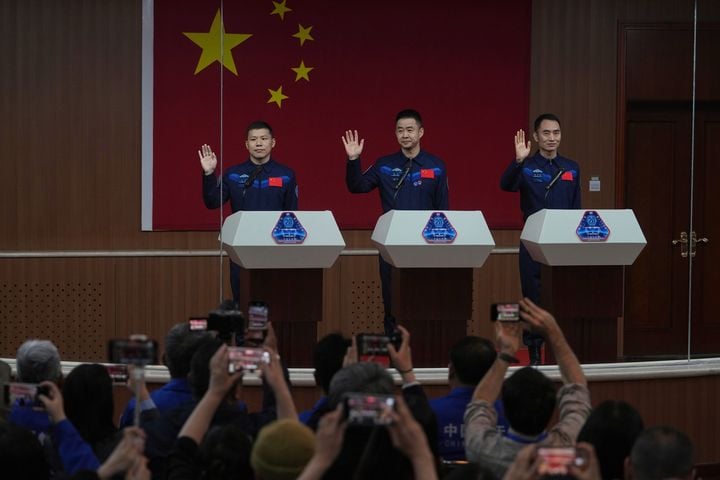
UPDATE: Three Chinese astronauts have successfully returned to Earth after a significant delay due to space debris damage. The crew, which includes astronauts Chen Dong, Chen Zhongrui, and Wang Jie, landed safely in the Gobi Desert following a nine-day postponement of their return from the Tiangong space station.
The astronauts had originally planned to return on November 5 but were forced to change their trajectory after their designated return capsule, Shenzhou-20, sustained damage from space debris. The China Manned Space Agency confirmed that a window in the capsule had developed tiny cracks, likely from an impact with debris that is known to travel at extreme speeds around the Earth.
In a remarkable pivot, the crew left their Shenzhou-20 spacecraft in orbit and returned home aboard the newly arrived Shenzhou-21 capsule, which had previously brought a replacement crew to the space station. The capsule deployed a red and white striped parachute before descending in the afternoon, approximately five-and-a-half hours after leaving the station.
The astronauts had been stationed at the Tiangong space station for six months, conducting vital experiments in collaboration with the new crew. Officials report that they are “in good condition, working and living normally” despite the extended stay.
This incident underscores the persistent dangers posed by space debris, which includes millions of pieces orbiting Earth. These fragments can originate from previous launches and collisions, creating risks for satellites, space stations, and astronauts conducting extravehicular activities.
The China Manned Space Agency has confirmed plans for the upcoming Shenzhou-22 mission, although specific launch dates remain undisclosed. The agency’s developments are crucial as China’s space program continues to advance, aiming to land a person on the Moon by 2030.
China’s space endeavors have progressed significantly since 2003, including the construction of the Tiangong space station, exploration of Mars with a robotic rover, and ongoing experiments crucial for future missions. The latest mission included the transport of four mice to study the effects of weightlessness, vital for mastering technology for breeding and monitoring small mammals in space.
As space exploration continues to evolve, the implications of this incident resonate beyond national borders, highlighting the risks and rewards of advancing technology in aerospace. Stay tuned for updates on the Shenzhou-22 mission and other developments in China’s ambitious space program.