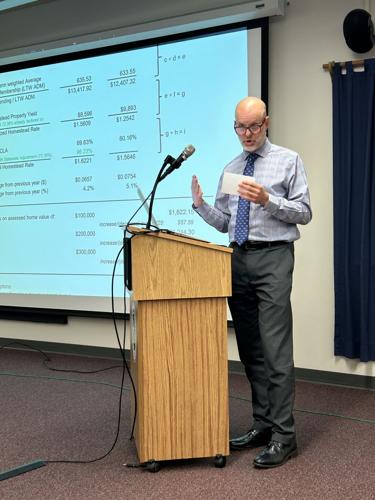
BENNINGTON — At a recent Select Board meeting, newly appointed school superintendent Tim Payne provided an overview of Vermont’s school funding process and discussed potential impacts of upcoming education reforms. As the leader of the Southwest Vermont Supervisory Union (SVSU), Payne highlighted the complexities involved in budgeting and taxation within the state’s unique educational framework.
Payne began by explaining the steps involved in forming a school budget, which starts at the local level with community votes during Town Meetings. He noted that while communities approve budgets, the state’s application of weighted formulas can lead to significant increases in school taxes, sometimes outpacing local budget growth. “My purpose this evening is to talk a little bit about school funding,” he remarked during the meeting. “Vermont is a relatively unique system.”
He elaborated on the budget process, outlining the key stages: local school boards draft budgets, communities vote on these budgets, and approved amounts are submitted to the state. The state then funds these budgets from the education fund, which is calculated based on the overall educational spending required for the coming year. This figure is divided by the number of students in each district to create an “Equalized Homestead Tax Rate,” which varies across towns.
Payne pointed out that the governor may sometimes propose measures to reduce property taxes by utilizing state surplus funds. “Last year, the governor made the decision to buy down property taxes,” he explained. This approach, while beneficial for taxpayers, raises concerns about sustainability. “You can’t count on the state government having a surplus every year,” he cautioned.
The discussion shifted to Act 73, a recent legislative initiative aimed at reforming Vermont’s education system. Payne indicated that this ambitious reform will unfold over five years, with specific milestones for legislative action. He noted, “They are required by December 1, 2023 to submit three maps that reimagine the school districts in the state of Vermont.”
Key timelines include the implementation of minimum class sizes in July 2026, the establishment of new school districts by January 2027, and the introduction of a foundation formula by July 2028. This foundation formula will fundamentally change funding mechanisms, directing state funding to districts based on a predetermined dollar amount per student.
“This will dramatically change the way education is conducted and funded in Vermont,” Payne stated. He emphasized the importance of community involvement in discussions about these reforms. “I would encourage folks to follow along,” he said, highlighting the potential for significant changes in education delivery.
As the state progresses with Act 73, Payne urged residents to engage with their elected officials to understand the implications of the reform. “Some people think this is going to save us a lot of money,” he noted, while also addressing the possibility of providing equitable opportunities for students across Vermont. The dialogue on these issues is poised to shape the future of education in the state significantly.
In conclusion, the Select Board meeting served as an important platform for discussing the intricate relationship between school funding and educational reform in Vermont. With ongoing changes on the horizon, the community is encouraged to stay informed and actively participate in shaping the future of local education.