United States President Donald Trump has openly rejected the relevance of international law, asserting that only his “own morality” can guide his administration’s aggressive foreign policies. His comments followed the US military’s controversial operation that resulted in the abduction of Venezuelan President Nicolas Maduro. In an interview with The New York Times on Thursday, Trump stated, “I don’t need international law. I’m not looking to hurt people,” while also suggesting that adherence to such laws depends on their definitions.
The recent military action in Venezuela, which included airstrikes across the capital, Caracas, has raised significant concerns regarding the legality of US actions under international law. The operation, described by critics as a violation of the United Nations Charter, involved US troops abducting Maduro. The UN Charter explicitly prohibits the use of force against the territorial integrity or political independence of any state.
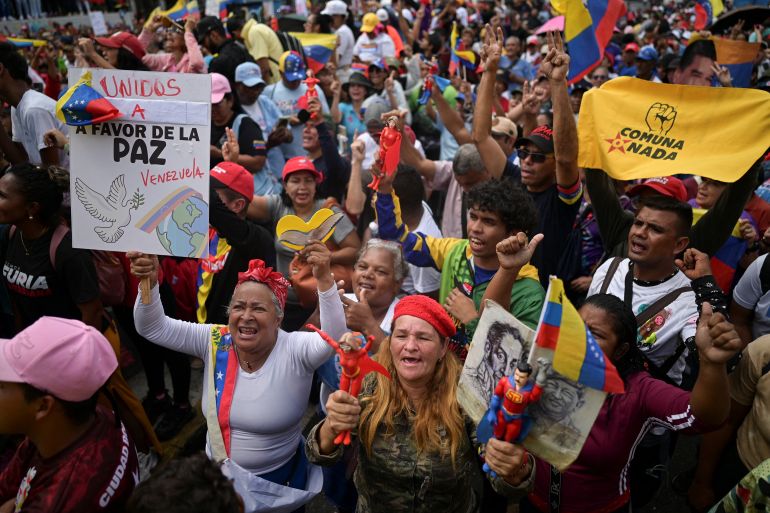
In the wake of these events, Trump has escalated his rhetoric, declaring that the US would “run” Venezuela and leverage its extensive oil reserves. Though his administration has indicated a willingness to collaborate with interim President Delcy Rodriguez, it has also stated intentions to “dictate” policy to her government. Trump warned Rodriguez that failure to comply with US demands could result in severe repercussions, stating, “If she doesn’t do what’s right, she is going to pay a very big price, probably bigger than Maduro.”
The Trump administration’s strategy has not been limited to Venezuela. Earlier this week, Trump hinted at the possibility of military action against Colombia’s leftist President Gustavo Petro. Additionally, he has pursued ambitions to acquire the Danish territory of Greenland and has supported military strikes against Iran.
The rhetoric surrounding US foreign policy has drawn criticism from various experts. Stephen Miller, a senior advisor to Trump, has openly criticized the post-World War II international order, asserting that the US would unapologetically use military force to secure its interests throughout the Western Hemisphere. He stated, “We’re a superpower, and under President Trump, we are going to conduct ourselves as a superpower.”
Concerns about the implications of disregarding international law have been voiced by several experts. Margaret Satterthwaite, the UN special rapporteur on the independence of judges and lawyers, described the dismissal of international law as “extremely dangerous.” She warned that such attitudes could pave the way for an “age of imperialism,” where adversarial states might feel emboldened to engage in their own aggressive actions. “International law cannot stop states from doing terrible things if they’re committed to doing them,” she remarked.
Similarly, Yusra Suedi, an assistant professor of international law at the University of Manchester, cautioned against the prevailing notion that “might is right.” She emphasized that this trend could encourage other nations, such as China and Russia, to follow suit in pursuing aggressive policies.
Ian Hurd, a political science professor at Northwestern University, underscored the historical consequences of US interventions in Latin America. He noted that a legacy of invasions and military coups has led to instability and human rights abuses in the region. “There are innumerable examples historically of this, from Panama to Haiti to Nicaragua to Chile in the ’70s,” Hurd stated. He expressed concern that Trump’s policies in Venezuela reflect a continuation of these historically regrettable interventions.
As the situation in Venezuela unfolds, the implications of the US stance on international law and military intervention continue to resonate, raising questions about future diplomatic relations and the potential for further conflict in the region and beyond.