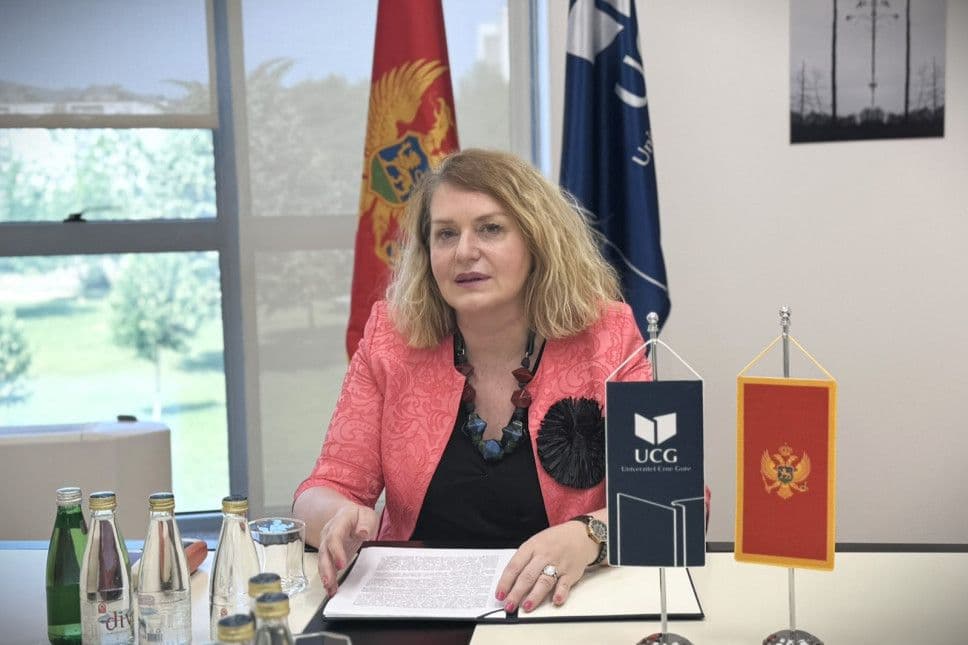
Prof. Dr. Branka Bosnjak, the advisor for strategic policies and sustainable development at the University of Montenegro, has expressed concern over the silence and passivity of the academic community in responding to societal issues. In an interview with Pobjeda, she emphasized that knowledge is the most powerful tool a society possesses and that the academic community should exemplify responsible and engaged behavior.
Throughout her career, Bosnjak has been a vocal critic of the university’s operations, including the management of current rector Vladimir Bozovic. She previously served as a member of parliament and the first vice-president of the Assembly, where she advocated for educational reforms and better compensation for professors, successfully lobbying for a salary increase of over 60 percent.
In discussing her transition from politics to the university, Bosnjak noted, “I have always been someone who expresses my views clearly and openly, including critical ones. Silence has never been my choice.” She highlighted the importance of constructive criticism aimed at the common good rather than personal or political vendettas.
Bosnjak’s commitment to elevating the academic profession includes her successful lobbying for the inclusion of university professors in the Public Sector Salary Law, which adjusted salary coefficients and recognized their professional status. She acknowledged that the university’s administration under Bozovic demonstrates openness and supports the freedom of thought, allowing her to continue advocating for necessary changes.
Despite recognizing the university’s achievements and activities, Bosnjak noted that many go unnoticed by the public. She criticized the trend whereby negative news receives greater attention than positive developments, citing instances where lectures by Nobel laureates and renowned professors remained largely unreported.
Calls for Depoliticization of University Governance
Bosnjak has been steadfast in her belief that the selection of the rector should be free from political influence, advocating for a process involving direct elections by the academic community. “The direct election of the rector through secret voting, after presenting a program and public debates, is the most democratic solution,” she stated, reflecting on her experiences at the University of Ljubljana, where she witnessed a more participatory electoral process.
The current selection process, she argued, is less democratic than during the single-party communist system, as it relies on a small board comprised of fifteen members, predominantly appointed by the government. This structure, according to Bosnjak, risks undermining the university’s independence and opens the door to political maneuvering.
She expressed concerns over the representation of academic staff on the board, which can potentially lead to decisions that do not reflect the interests of the university community. “It is crucial that politics does not dominate university matters,” Bosnjak insisted.
Addressing Challenges and Advocating for Change
Reflecting on the state of the university, Bosnjak noted a concerning level of self-censorship among faculty members regarding critical issues affecting society. “The silence of the academic community is, in my opinion, as harmful as ignorance,” she remarked. She believes that professors have a moral obligation to address societal issues and foster a culture of open dialogue.
Bosnjak has initiated a project aimed at establishing a scientific database at the university to connect academic experts with government bodies in developing legislation and strategies. Although the initiative has received support from university leadership, she expressed frustration at the lack of response from the government regarding a proposed memorandum of collaboration.
She underscored the need for the academic community to engage actively with pressing social topics, such as environmental issues and public health, and to organize public discussions that tackle sensitive subjects.
As she continues her role at the university, Bosnjak remains committed to fostering a culture of academic engagement and transparency, believing that the institution must adapt to the evolving needs of society while maintaining its integrity.