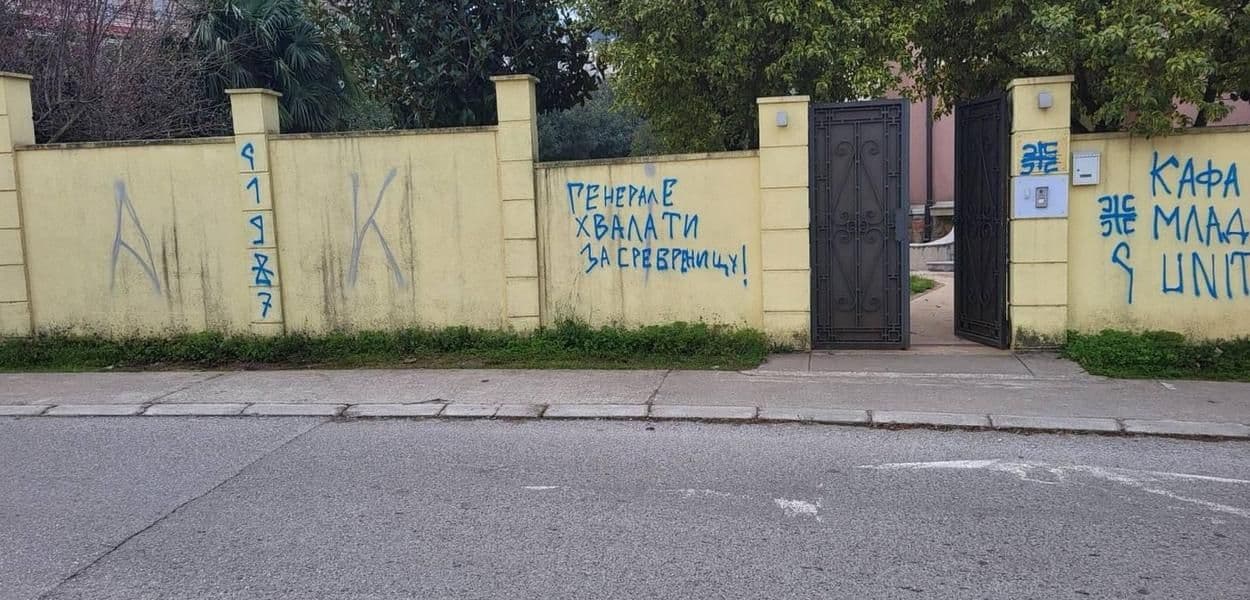
UPDATE: Authorities in Montenegro are responding urgently to hate messages discovered on the walls of the Bosnia and Herzegovina Embassy in Podgorica. The graffiti, including the phrase “Generale, hvala ti za Srebrenicu” (General, thank you for Srebrenica), was found yesterday, coinciding with the 30th anniversary of the Srebrenica genocide, where over 8,000 Bosniaks were killed.
The hateful messages, including references to the convicted war criminal Ratko Mladić, have sparked outrage across the region. Montenegro’s Foreign Ministry condemned the vandalism, calling it a direct attack on diplomatic missions and fundamental civilizational values. The ministry stated, “This despicable act glorifies genocide and celebrates a convicted war criminal,” highlighting the urgency of addressing such incidents.
Branimir Jukić, the Ambassador of Bosnia and Herzegovina in Montenegro, expressed gratitude for the swift response from Montenegrin institutions. In a statement, he noted that he received immediate calls from the Ministry of Foreign Affairs and Minister Ervin Ibrahimović following the public outcry. “We are motivated to strengthen cooperation between Montenegro and Bosnia and Herzegovina,” Jukić remarked.
The police are yet to release an official statement regarding the investigation, but public condemnation is widespread. The graffiti on the embassy wall has already been painted over, while a menorah at the Argentine Square, which was also vandalized with hate symbols, has been removed.
The incident has ignited discussions about the rising tide of hate speech in Montenegro. Organizations such as the Human Rights Action (HRA) and the Civic Alliance have called for immediate identification and prosecution of those responsible, stressing that public approval of genocide is a punishable offense under Montenegrin law.
Montenegro’s Ministry of Foreign Affairs reiterated its commitment to combating hate speech and upholding the truth about the Srebrenica genocide. They emphasized that glorifying war criminals contradicts the nation’s commitment to regional reconciliation and stability.
In a broader context, this incident comes as Montenegro prepares to commemorate December 19, known as the Day of Liberation in Podgorica, a date that symbolizes anti-fascist struggle and the defeat of criminal ideologies. Activists warn that such acts of vandalism threaten to undermine these values and are symptomatic of historical revisionism gaining ground in the region.
The Srebrenica genocide, recognized by international courts, remains a pivotal issue in the Balkans. Montenegro’s parliament adopted a resolution acknowledging this atrocity in 2021, yet incidents like these reveal ongoing challenges in confronting the legacy of violence.
As tensions rise, all eyes are on the Montenegrin authorities for a decisive response to this alarming act of hate. Public and political scrutiny will likely increase as the government seeks to reaffirm its commitment to human rights and historical truth.
Stay tuned for further updates as this story develops.