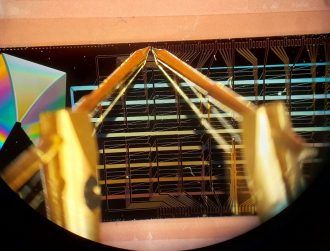
The Tyndall National Institute will spearhead the Irish segment of a significant €50 million European initiative called Photonics for Quantum (P4Q). This initiative, coordinated by the University of Twente in the Netherlands, aims to enhance the manufacturing ecosystem for quantum photonic chips across twelve countries in Europe. By uniting leading research institutions, semiconductor foundries, and deep-tech companies, the project seeks to accelerate the development and production of quantum technology.
The initiative responds to the urgent need for high-quality quantum photonic chips, which are essential for advancements in quantum sensing, communication, and computing. As the global competition in quantum technology intensifies, scaling production has become critical. The consortium’s objective is to establish a reliable manufacturing ecosystem capable of producing these chips in large volumes.
Tyndall National Institute, based at University College Cork, will contribute its expertise in advanced packaging technologies specifically designed for cryogenic temperature operations. Tyndall’s Chief Executive Officer, Prof William Scanlon, remarked, “P4Q represents an important milestone for Europe’s quantum and semiconductor ambitions. Advancing the packaging of quantum photonic chips is essential for building a scalable manufacturing base in Europe.”
Collaborative Efforts Across Europe
Among the partners involved in the P4Q initiative are esteemed institutions such as the Austrian Institute of Technology, Alpine Quantum Technologies, and CEA-Leti in France. Additionally, companies like Delft Networks, Sparrow Quantum in Denmark, and VTT in Finland are also part of the consortium. This collaborative effort positions Europe to lead in the rapidly evolving quantum technology landscape.
Prof Peter O’Brien, head of photonics packaging at Tyndall, emphasized the significance of the project for Ireland, stating, “P4Q provides Ireland with a unique opportunity to lead the development of advanced packaging technologies for quantum devices. With our state-of-the-art infrastructure and unique expertise, Ireland is exceptionally well positioned to stay at the forefront of quantum research and industrialization, fully aligned with our national semiconductor strategy.”
The project is co-funded by the Department of Further and Higher Education, Research, Innovation and Skills in Ireland, indicating strong governmental support for the initiative.
Investment in Semiconductor Research
In a related development, the European Union recently launched the second of its five Chips Act pilot lines, named NanoIC. This pilot line represents a combined investment of €2.5 billion and aims to deploy state-of-the-art extreme ultraviolet lithography technology. Tyndall is set to gain from its role as a partner in the NanoIC pilot line, further enhancing its capabilities in semiconductor research and development.
Last month, Tyndall announced an expansion package exceeding €100 million, which aims to double its operational footprint. This expansion is a strategic move to strengthen Ireland’s position in global semiconductor research and development.
As the demand for quantum photonic chips escalates, initiatives like P4Q and investments in semiconductor technology underscore the importance of collaboration and innovation in maintaining competitive advantages in this critical sector.