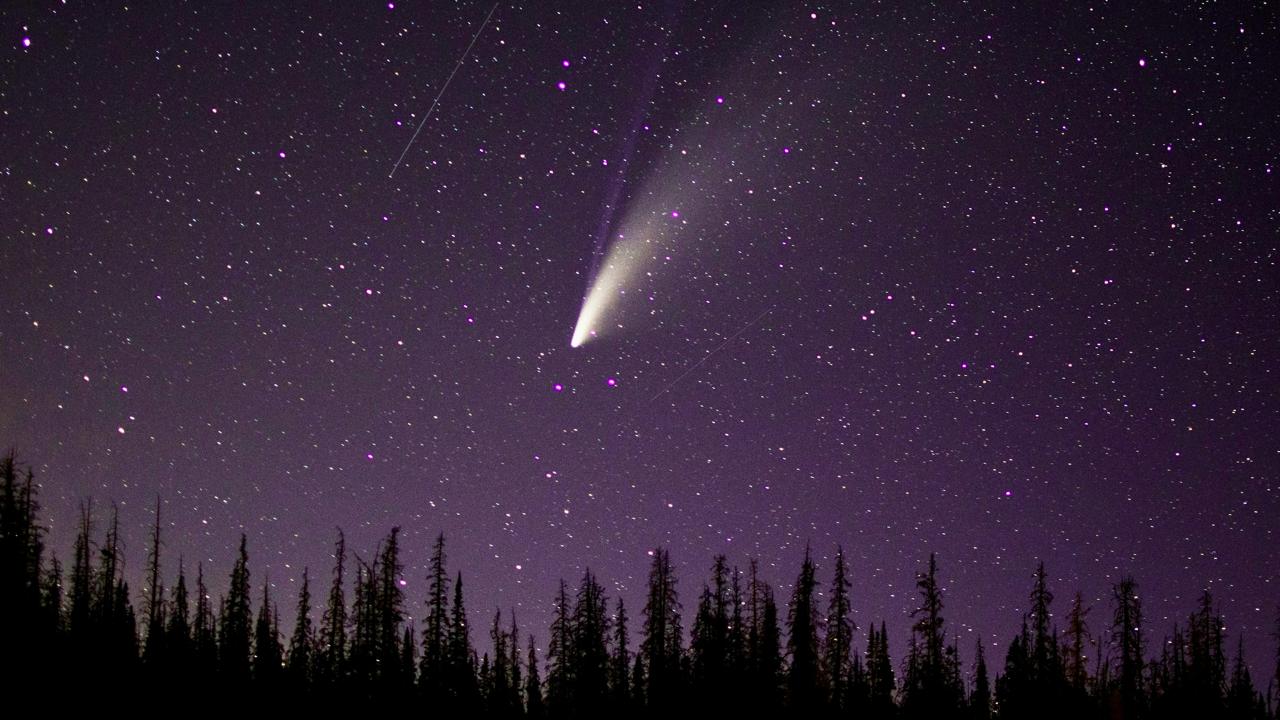
A recent photograph of the interstellar comet 3I/ATLAS, taken by the Hubble Space Telescope, has ignited intense discussions within the astronomical community. The image, captured on November 30, 2023, showcases the comet approximately 178 million miles (or 286 million kilometers) from Earth, presenting features that some observers deem inexplicable. This renewed scrutiny follows a claim by an anonymous user on social media who outlined five characteristics of the comet that challenge conventional understanding.
The debate escalated when the user, operating under the pseudonym 3I/ATLAS WHISTLE BLOWER, shared the Hubble image and asserted that it depicted “five impossible things in ONE photo.” They urged followers to closely examine the image, describing the comet as “a perfect glowing blue sphere with laser beams and peeling rings.” This claim quickly garnered attention from both amateur astronomers and seasoned experts, prompting a wave of analysis and speculation regarding the comet’s unusual attributes.
Unpacking the Claims of Unusual Features
The first assertion from the whistleblower focuses on the apparent spherical shape of 3I/ATLAS. The account states, “The blue ball is perfectly round — less than 2% out of shape.” This observation contrasts sharply with typical cometary bodies, which are generally expected to have irregular forms due to the uneven loss of material. If confirmed, a near-perfect spherical shape would represent a significant deviation from established comet characteristics. However, it remains unclear whether the roundness is due to the comet’s nucleus or the outer gas cloud, known as the coma, illuminated by solar radiation.
The second point of contention involves two linear features extending from the comet, which the account claims are “two beams shooting out DEAD opposite — 180.000° accurate.” This claim suggests an extraordinary level of precision, described as “50× more perfect than any comet ever photographed.” Typically, gas and dust streams released from comets do not exhibit such exact geometries, leading to questions about the validity of this observation.
The whistleblower also highlights the presence of three glowing rings encircling 3I/ATLAS, suggesting that they adhere to the mathematical principles of the golden ratio, approximately 1.618. The user argued that such precision is unlikely to arise from natural processes, asserting, “That’s the math behind flowers and galaxies. Not random ice explosions.” While ring-like patterns can form from dust released in bursts, the suggestion that they follow specific numerical relationships requires careful investigation.
Assessing the Scientific Validity of Observations
The fourth claim pertains to small, luminous spots within the comet’s jets, stated to be “spaced EXACTLY one rotation apart.” The account likened this spacing to a controlled signal, suggesting that the comet is “literally breathing on a timer.” Such observations necessitate a thorough analysis, accounting for exposure time, the object’s movement, and Hubble’s tracking capabilities for rapidly moving targets. Determining whether these luminous points represent separate occurrences, background objects, or camera artifacts remains a challenge for astronomers.
Finally, the whistleblower posited that the comet’s color aligns with that of pure cyanide gas glowing at a temperature of 10,200 K, claiming it is “twice as hot as it has any right to be.” While cyanogen is a common component in comets, the temperatures mentioned in the post exceed typical values for gaseous comas. As of now, NASA has not confirmed these temperature readings, nor has it addressed the various claims circulating online.
The agency’s official announcement regarding the Hubble image referred to the object as simply comet 3I/ATLAS, the third confirmed interstellar visitor to our solar system, without acknowledging any unusual characteristics. As the conversation continues, the scientific community is faced with the task of deciphering the meaning behind the striking features captured in the Hubble photograph.
In summary, the recent Hubble image of 3I/ATLAS has sparked a lively discourse concerning its peculiar characteristics. Whether these attributes indicate novel physical phenomena or result from misinterpretation remains uncertain. For now, the combination of scientific curiosity and bold claims ensures that the debate surrounding this celestial object is far from over.