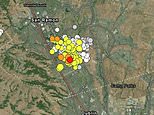
More than 300 earthquakes have struck the San Ramon area of California over the past month, raising concerns among residents about a potential major seismic event. This series of tremors, which began on November 9, 2025, has kept locals on edge, particularly since the region sits atop the Calaveras Fault, an active part of the larger San Andreas Fault system.
The US Geological Survey (USGS) has recorded these quakes, with the strongest measuring a magnitude of 3.8. The latest tremor, occurring today, registered a magnitude of 2.7. The Calaveras Fault has the potential to produce an earthquake of up to 6.7 magnitude, which could have devastating effects on millions in the San Francisco Bay Area. According to USGS estimates, there is a 72 percent chance of such an event occurring by 2043.
Concerns regarding the ongoing seismic activity have led to heightened anxiety in the community. Sarah Minson, a research geophysicist with the USGS’s Earthquake Science Center, emphasized the emotional toll these repeated tremors can take on residents. “This is a lot of shaking for the people in the San Ramon area to deal with. It’s quite understandable that this can be incredibly scary and emotionally impactful,” she stated.
Despite the frequency of these quakes, experts like Minson and her colleague Annemarie Baltay maintain that this activity does not necessarily indicate a larger earthquake is imminent. “Given the magnitude and locations of the earthquakes that have happened so far, there is no significant risk of something happening on one of the major faults,” Baltay explained. She further noted that these smaller quakes are common and often do not lead to larger seismic events.
Historical data supports this perspective. The area has experienced similar earthquake swarms in past decades, including in 1970, 1976, 2002, 2003, 2015, and 2018, without any significant follow-up quakes. Minson highlighted that such patterns have been observed repeatedly, reassuring the public that no major earthquakes followed these swarms in the past.
The complexity of the fault system in the San Ramon region contributes to the phenomenon. Studies conducted by seismologists, including Roland Burgmann from UC Berkeley, indicate that the region consists of multiple small faults rather than a single, dominant one. The quakes appear to interact with each other in a complex manner, with some researchers suggesting that underground fluids could be influencing these seismic events. “We think that what’s going on… is that there are a lot of fluids migrating through the rocks and opening up little cracks to make a bunch of little earthquakes,” Minson stated.
While some scientists have explored various potential causes for the swarms, including tidal forces, they found no definitive link. Emily Brodsky, a seismologist at UC Santa Cruz, acknowledged the puzzling nature of the current tremors, stating, “Although it’s the kind of thing you might expect to happen before a big earthquake, we can’t distinguish that from the many, many times that have happened without a big earthquake.”
As residents of San Ramon navigate this period of uncertainty, they are reminded of the importance of preparedness in earthquake-prone areas. The current series of quakes serves as a stark reminder that while the science surrounding earthquakes can provide insights, the unpredictability of nature remains.