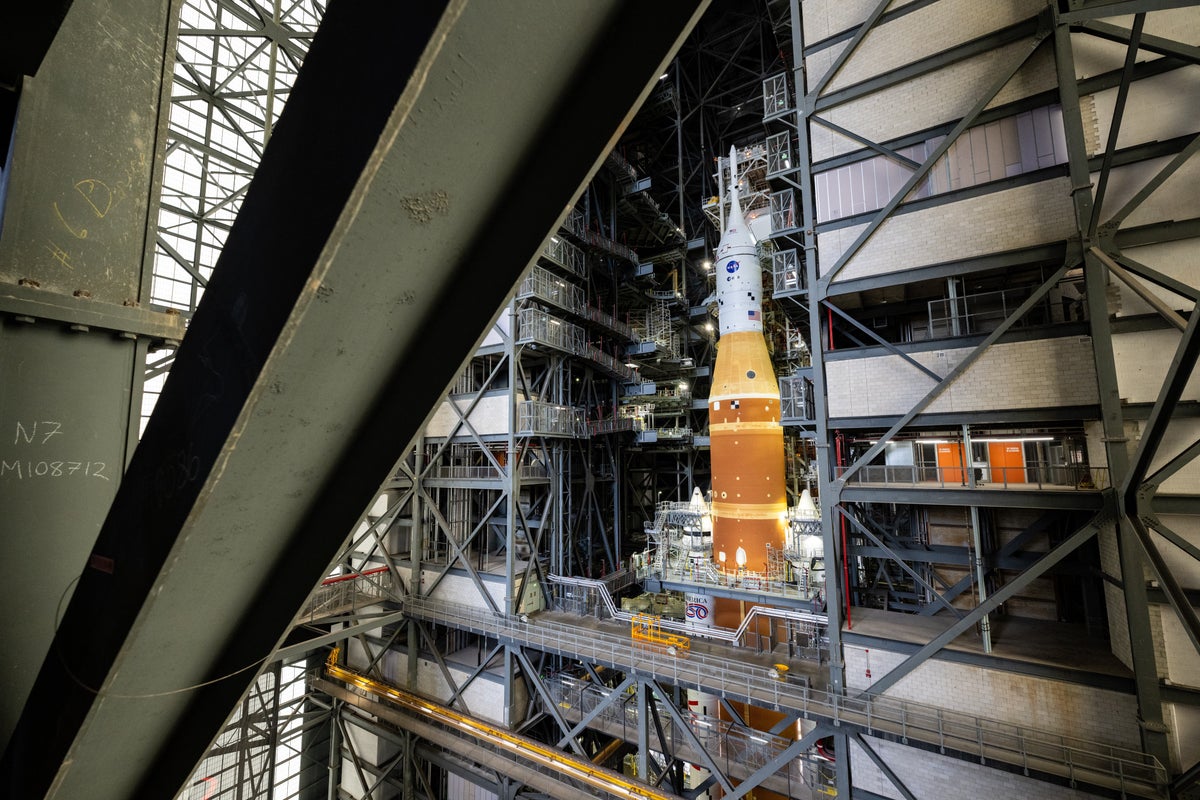
NASA is preparing to launch astronauts around the Moon for the first time in over 50 years. The agency successfully moved its Space Launch System (SLS) rocket and Orion spacecraft to the launch pad at the Kennedy Space Center in Florida on Saturday. This marks a significant step ahead of the Artemis II mission, which is scheduled to open its launch window on February 6, 2024.
The upcoming 10-day mission will be the first crewed journey around the Moon since the Apollo 17 mission in 1972. Following Artemis II, NASA plans to conduct Artemis III, which aims to return humans to the lunar surface. NASA describes the Artemis program as a platform for scientific discovery and economic benefits, paving the way for future crewed missions to Mars.
The journey to the launch pad spanned approximately four miles and was facilitated by NASA’s crawler-transporter 2 vehicle. This operation is expected to take up to 12 hours. Once on the pad, engineers will prepare the rocket and spacecraft for a rehearsal test that includes loading propellants.
Jared Isaacman, NASA Administrator, expressed confidence in the mission, stating it fulfills a commitment to the American public to return to the Moon. He emphasized the Moon’s potential as a testing ground for autonomous spacecraft capabilities. During a press conference at the Kennedy Space Center, Isaacman remarked:
“Now, day one of the moon base is not going to look like this glass-enclosed dome city that we might imagine someday. That’s certainly what the ideal end state would be.”
He noted that initial efforts may involve autonomous rovers focused on tasks like mining and mineral extraction. The concept of incorporating artificial intelligence into future missions, such as a potential mission to Venus, was also discussed.
The Artemis II crew includes NASA astronauts Reid Wiseman, Victor Glover, and Christina Koch, along with Jeremy Hansen from the Canadian Space Agency. Hansen highlighted the mission’s significance, stating it is “good for humanity” and acknowledging his newfound appreciation for the Moon.
Koch added, “As astronauts, one of the qualities we talk about a lot is adaptability.” She emphasized the importance of being prepared for unexpected challenges, stating that the Moon serves as a “witness plate” for understanding Earth’s history and the solar system’s formation.
Upon completion of the mission, the Orion spacecraft will splash down in the Pacific Ocean, where recovery operations will be conducted by the US Navy. The Artemis II mission represents a crucial step in humanity’s ongoing exploration of space, aiming to deepen our understanding of the Moon and its relationship to Earth and beyond.