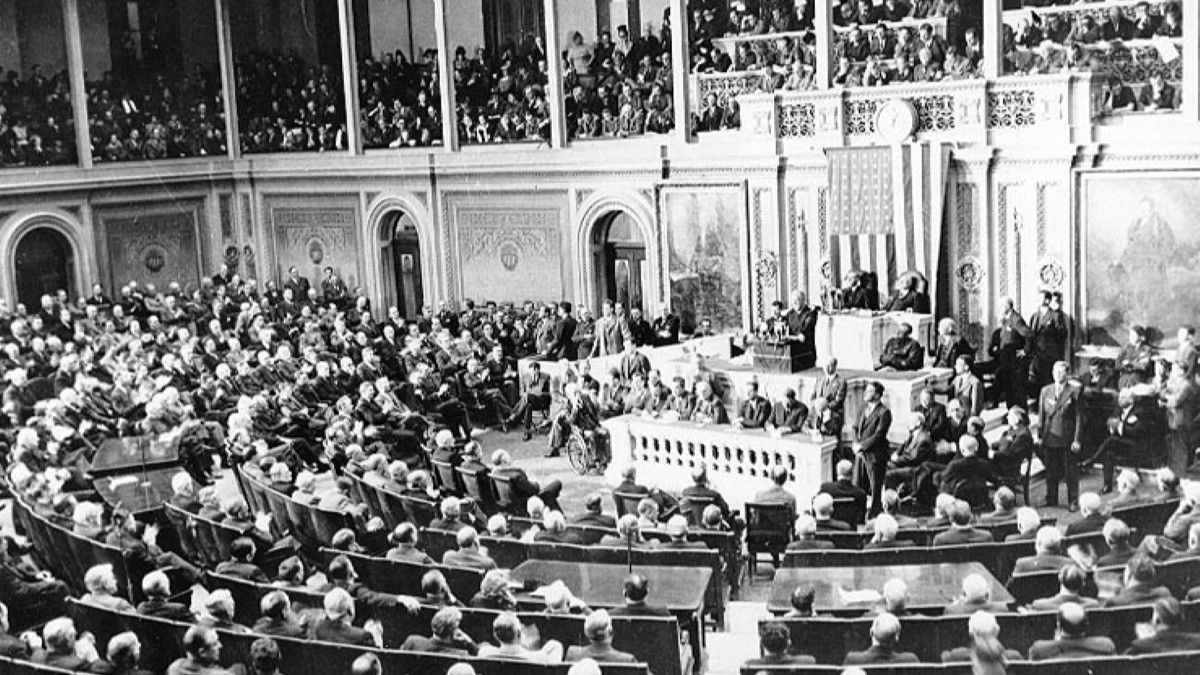
President Franklin Delano Roosevelt’s January 6, 1941, address to Congress highlights the crucial role of the defense industry during a time of global conflict, emphasizing the need for increased armament production. This speech, part of Roosevelt’s Four Freedoms campaign, serves as a historical reminder of America’s commitment to supporting allies against aggression. In light of current international tensions, Roosevelt’s insights into production challenges resonate strongly today.
In his address, Roosevelt outlined the importance of sending material support to nations resisting Axis powers. He stated that America’s national policy is to ensure comprehensive national defense, emphasizing bipartisan support for military preparedness. Roosevelt asserted, “Our national policy is this: First, by an impressive expression of the public will and without regard to partisanship, we are committed to all-inclusive national defense.” This call to action underscores the significance of unity in the face of threats.
Roosevelt’s tone was more pragmatic than in his earlier speeches. He acknowledged the specific challenges facing the defense industry, including production delays and resource constraints. Noting that “today’s best is not good enough for tomorrow,” he urged Congress to take swift action to enhance the nation’s armament capabilities. He expressed dissatisfaction with the progress made, stating that the country needed to accelerate production to meet the demands of war.
As he addressed Congress, Roosevelt highlighted the necessity of adapting the nation’s industrial output from peacetime to wartime. He noted that transforming a country’s production capabilities involves significant hurdles, particularly at the outset of such a transition. “To change a whole nation from a basis of peacetime production of implements of peace to a basis of wartime production of implements of war is no small task,” Roosevelt said, pointing to the importance of new tools and facilities.
Roosevelt’s call for increased appropriations and authorizations reflects a deep understanding of the complexities involved in military readiness. He requested additional funds to manufacture munitions and war supplies to support those engaged in combat against aggressors. His emphasis on acting as an “arsenal for them as well as for ourselves” illustrates the interconnectedness of global defense efforts.
The historical context of Roosevelt’s speech serves as a reminder that concerns about production capacity and funding are not new. As the world faces renewed geopolitical challenges, the lessons from Roosevelt’s era remain relevant. The ability of Congress to respond effectively to defense needs is critical. Roosevelt’s divided Congress was ultimately persuaded to support the necessary expenditures, a model that current lawmakers may need to consider.
Roosevelt’s address also touched upon the moral imperative tied to national security. He articulated that the principles of morality and considerations for security would never allow the nation to accept peace dictated by aggressors. This sentiment resonates today as democracies continue to confront threats to freedom and sovereignty.
As the year 2026 unfolds, Roosevelt’s insistence on rapid increases in armament production echoes in today’s defense discussions. The challenges faced by the defense industry, including production capacity and funding limitations, remain pressing issues. Roosevelt’s call for an urgent and unified response to these challenges serves as a blueprint for contemporary policymakers.
In conclusion, President Roosevelt’s address to Congress not only outlined the strategic necessities of the time but also reinforced the importance of a collaborative approach to national defense. His words remind us that the ongoing commitment to support allies and to strengthen our own defenses is essential for ensuring a secure future. As the world continues to grapple with threats, the lessons learned from Roosevelt’s leadership remain profoundly relevant.