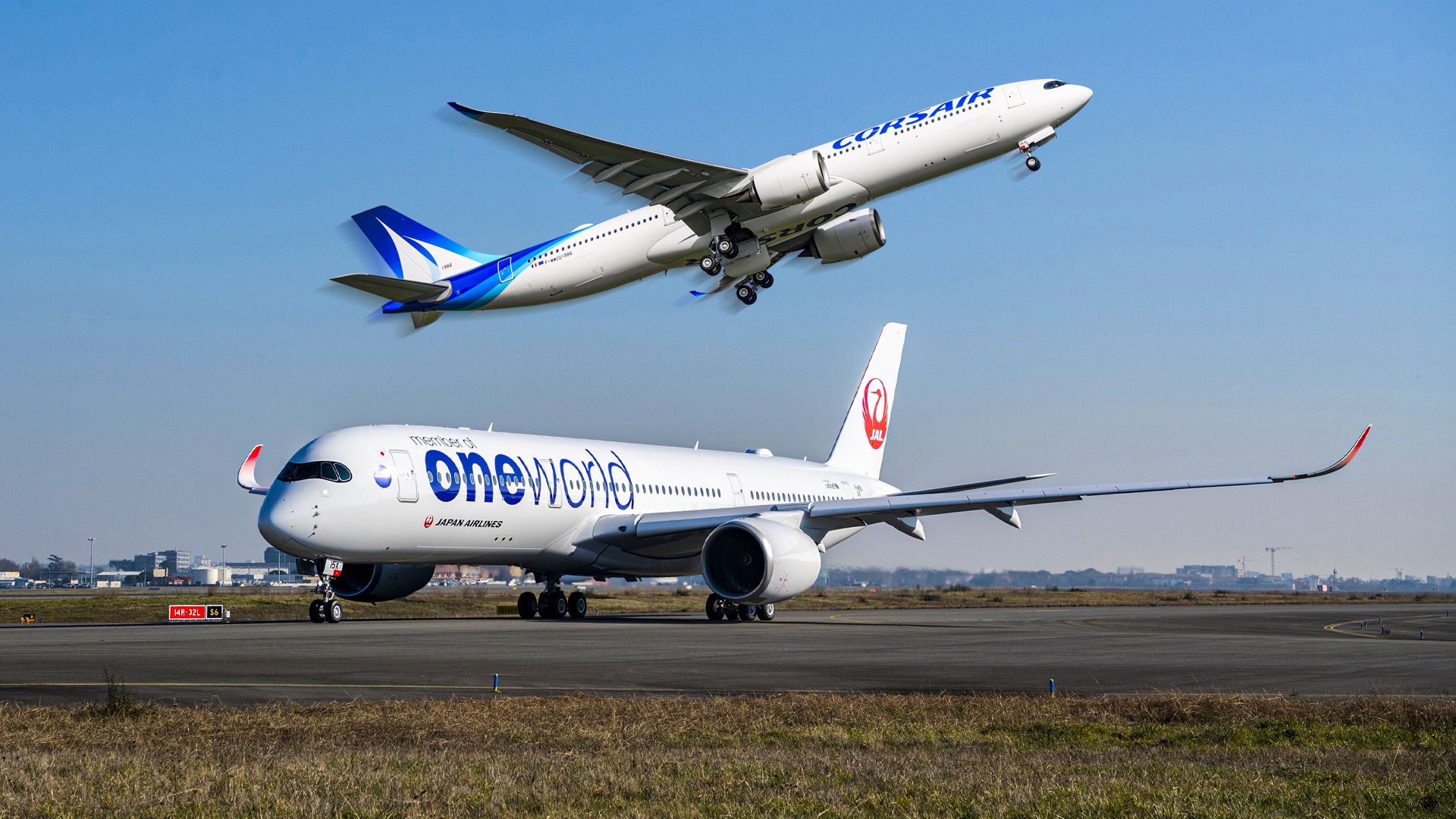
The Airbus A350-900 and the A330-900neo, while visually similar, represent distinct philosophies in aircraft design and functionality. The A350-900, a product of cutting-edge technology, contrasts with the A330-900neo, which builds upon a classic framework. Airlines often utilize both models, understanding their unique capabilities and operational efficiencies. This analysis explores the dimensions, capacities, and operational advantages of these aircraft.
Comparative Dimensions and Capacity
In terms of physical size, the A350-900 clearly surpasses the A330-900neo. The A350 measures **66.8 meters** (219 ft 2 in) in length, making it over **three meters** longer than the A330-900, which is **63.69 meters**. This additional length allows the A350 to accommodate more seating rows and increased under-floor cargo space, enhancing its revenue potential on popular routes.
One of the most notable differences lies in the wingspan. The A350-900 boasts a wingspan of **64.75 meters**, designed for optimal cruising at high altitudes. In contrast, the A330-900 features a revised wing design stretching to **64 meters**, equipped with new sharklets. The A350’s advanced wing, constructed from carbon-fiber-reinforced plastic, is capable of changing shape during flight to reduce drag, a feature the A330-900’s wing does not replicate.
The fuselage width also plays a crucial role in passenger experience. The A350-900 has an external diameter of approximately **5.96 meters**, compared to the A330-900neo’s **5.64 meters**. This **32-centimeter** difference shifts the internal layout, transforming the A350 from a traditional widebody to a true heavy-class airframe.
Inside, the impact of this width difference is significant. The A330-900 features a cabin width of approximately **5.26 meters**, supporting a **2-4-2** seating configuration. While this layout is favored by travelers seeking to minimize the number of middle seats, it restricts total passenger capacity compared to the A350’s **3-3-3** configuration, which comfortably maintains **18-inch** seat widths. The A350’s interior design, with sculpted sidewalls and vertical cabin walls, enhances personal space, making the cabin feel considerably larger.
Operational Efficiency and Range
The operational capabilities of these aircraft further highlight their differences. The A330-900, with a maximum takeoff weight (MTOW) of **251 tonnes**, excels in medium-to-long-haul flights. Conversely, the A350-900 has a significantly higher MTOW of **283 tonnes**, allowing it to carry more fuel and extend its range. The A350 can cover approximately **8,100 nautical miles**, whereas the A330-900 has a maximum range of **7,350 nautical miles**. This difference is crucial for airlines aiming to connect distant markets, particularly from the United States to Asia.
The A350-900 is powered by **Rolls-Royce Trent XWB** engines, which provide greater thrust than the Trent 7000 engines on the A330-900. This added power allows the A350 to operate from challenging high-altitude airports, such as **Addis Ababa**, while still carrying full loads of passengers and cargo. As a result, the A350-900 is perceived as a more versatile option for airlines.
The A330-900, while not lacking in performance, is optimized for specific routes that do not require the extensive range and capacity of the A350. Airlines like **Delta Air Lines** and **Virgin Atlantic** strategically deploy both aircraft, using the A330-900 for high-capacity regional and transatlantic flights while reserving the A350 for ultra-long-haul operations.
Both aircraft offer advanced cabin features, including larger overhead bins, improved mood lighting, and quieter environments. These enhancements contribute to passenger comfort, a significant consideration for airlines aiming to provide a superior travel experience.
In conclusion, the Airbus A350-900 and A330-900neo serve complementary roles within airline fleets. While the A350 stands out as a technologically advanced aircraft designed for ultra-long-haul operations, the A330-900neo provides a cost-effective solution for medium-to-long-haul routes. As airlines continue to modernize their fleets, the partnership between these two aircraft will likely shape the future of long-haul travel, meeting the demands of both efficiency and passenger comfort.