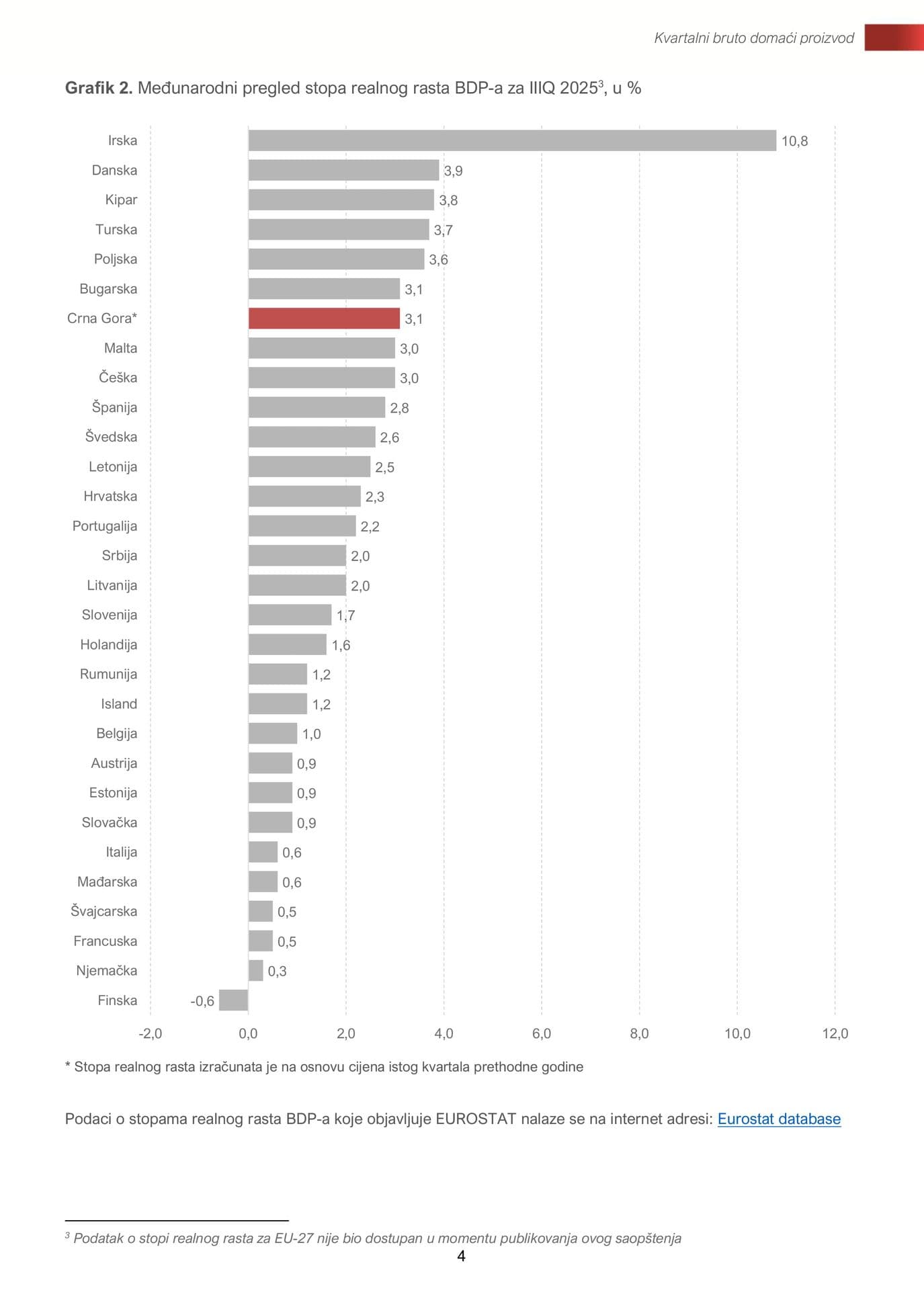
Montenegro’s economy has shown robust growth, with the country’s Gross Domestic Product (GDP) recording a real increase of 3.1% in the third quarter of 2023. Preliminary data from the Statistical Office of Montenegro, known as Monstat, indicates that the GDP reached €2.57 billion, an increase from €2.39 billion during the same period last year. This impressive growth positions Montenegro seventh in Europe for economic performance.
According to Eurostat, Montenegro’s growth outpaces several notable European nations, including Croatia, which saw a growth rate of 2.3%, and Serbia at 2%. The country also surpassed Malta’s 3%, Spain’s 2.8%, Sweden’s 2.6%, Slovenia’s 1.7%, Belgium’s 1%, Italy’s 0.6%, Hungary’s 0.6%, Switzerland’s 0.5%, France’s 0.5%, and Germany’s 0.3%.
The figures released by Monstat utilize the production and consumption methods in accordance with the European System of Accounts 2010 (ESA 2010) methodology. The GDP calculation encompasses the overall value of goods and services produced by resident institutional units.
Understanding the Growth Drivers
Monstat explained that the GDP includes all activities within the production boundaries defined by the SNA 2008 and ESA 2010 methodologies, covering the entire territory of Montenegro. The estimates also account for the informal economy to some extent. The classification of economic units by activity aligns with the 2010 Classification of Economic Activities, which is synchronized with the NACE Rev.2 classification used across the European Community.
The main components of GDP, as determined by the consumption method, include household personal consumption, expenditure by non-profit institutions serving households (NPISH), government consumption, gross investments in fixed assets, changes in inventories, and the balance of exports and imports of goods and services.
Monstat elaborated that household personal consumption expenditures are calculated based on regular statistical surveys, including household consumption surveys and data from agriculture, industry, foreign trade statistics, and price statistics. The calculations are carried out using the commodity flow method at a detailed level of personal consumption classification according to purpose (COICOP 2018).
Investment and State Spending Insights
Government consumption expenditures are derived from data provided by the Ministry of Finance, utilizing the ESA 2010 methodology. This includes individual expenditures for education, healthcare, social protection, sports, culture, and recreation. Other state expenditures represent collective consumption, encompassing general public services, defense, public order and safety, economic affairs, and environmental protection.
Gross investments in fixed assets are calculated based on regular statistical surveys and data from the Tax Administration and Customs Administration. Exports and imports of goods and services rely on trade statistics from Monstat, Customs Administration data, and the Balance of Payments data from the Central Bank.
These findings highlight Montenegro’s significant economic advancements compared to its regional counterparts and illustrate a resilient growth trajectory that may attract further investment and development opportunities in the coming quarters.