Vodafone has achieved a groundbreaking milestone by enabling the world’s first-ever video call from space using a standard mobile phone, a feat accomplished in late January 2025. This historic event took place from a specially modified location in Newbury, UK, and promises to revolutionize mobile connectivity, potentially eliminating mobile “dead zones” across the country.
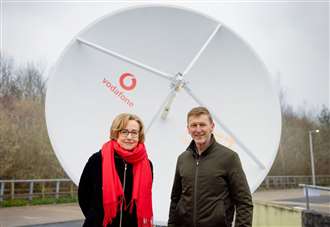
The project began in December 2024, presenting a significant logistical challenge: where to position a satellite dish weighing one tonne and measuring 2.4 meters across. This vital piece of equipment required an unobstructed view of the sky to track satellites traveling at remarkable speeds. After evaluating various sites, the team determined that the top deck of Vodafone’s office car park at The Connection in Newbury was the most suitable location.
Delivery of the satellite dish faced a setback as the team awaited a plane large enough to transport it from Europe. Once it arrived, the team encountered further complications due to height restrictions that rendered cranes and forklifts unusable. According to Vodafone engineer Sami Gabriel, a Newbury resident, “I think there was 10 of us on site doing that assembly. In the R&D team, we do a lot of trials so it’s a matter of finding a way to make it happen – no is not an acceptable answer.”
To power the setup, the team ran a 100-meter extension cord from the main building, as the car park only provided enough electricity for lighting. While part of the team worked on assembling the satellite gateway in Newbury, another group was tasked with identifying a “not-spot” – an area devoid of mobile signal – to test the technology’s effectiveness. Lead engineer Rowan Chesmer, along with colleague Abdirahman Farrah and his dog Odin, ventured into the remote valleys of Wales. They faced harsh winter conditions, navigating snow-covered paths, flooded roads, and fallen trees to find an ideal testing location.
“You can’t see anything, but you hold a spectrum analyser up and you can clearly see the signal,” Chesmer explained. “It looks really boring when you’re doing it, but it’s incredibly exciting when there’s something there.”
As the project progressed, anxiety mounted back in Newbury. The satellites’ constant movement created limited timeframes – approximately 10 to 20 minutes – for establishing a connection before they disappeared from view. Chesmer noted, “There was a running bet as to which satellite would make the first call.”
In the early hours of January 29, 2025, the anticipation culminated in success. The team successfully placed a voice call, followed by a historic video call with Vodafone’s CEO, Margherita Della Valle. Unlike traditional phones, which connect through masts located roughly 4 kilometers away, this technology utilizes satellites positioned over 500 kilometers in space. The absence of physical obstructions in orbit ensures a strong and reliable signal.
The temporary setup at the Newbury car park has since been relocated to a permanent facility, with Vodafone announcing plans to launch commercial services by late 2026. These services aim to provide 4G and 5G coverage across even the most remote areas, enhancing connectivity for users regardless of their location.
This innovative project not only highlights Vodafone’s commitment to advancing communication technology but also sets a precedent for future developments in space-based mobile connectivity.