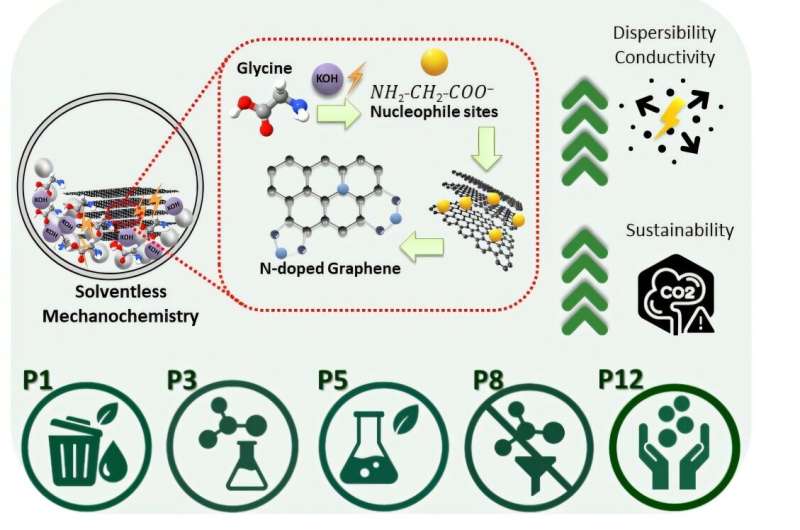
Graphene, often hailed as a revolutionary material, is renowned for its remarkable strength, electrical conductivity, and versatility. Despite over a decade of research, many graphene-based technologies remain confined to laboratory settings. A primary barrier is the difficulty in effectively modifying graphene for practical use, which typically requires environmentally taxing processes. Recent research from a team at Monash University, led by Chamalki Madhusha, introduces a more sustainable method for producing nitrogen-doped graphene nanoplatelets (N-GNPs) through a solvent-free, mechanochemical approach.
Challenges in Graphene Functionalization
While pristine graphene boasts excellent properties, its application in advanced technologies such as smart coatings and self-healing materials often necessitates chemical modifications. One prevalent method is nitrogen doping, which enhances graphene’s electronic structure and improves its compatibility with various solvents and polymers. However, traditional nitrogen-doping techniques frequently involve toxic nitrogen precursors, extensive purification processes, and high-temperature treatments exceeding 600 °C. These methods not only generate considerable chemical waste but also pose significant sustainability concerns, especially as the manufacturing industry increasingly prioritizes environmentally friendly practices.
In their study published in ACS Sustainable Chemistry & Engineering, Madhusha and her colleagues tackled these challenges head-on. By employing mechanochemistry, they harnessed mechanical forces such as shear and friction to facilitate chemical reactions without the need for solvents. This innovative ball-milling process used a bio-derived nitrogen source—amino acids—allowing for direct functionalization of graphite at ambient conditions. The resulting N-GNPs exhibited high electrical conductivity and excellent dispersibility, effectively addressing two critical issues in graphene processing.
Assessing Sustainability and Performance
To accurately assess the sustainability of their production method, the researchers evaluated both qualitative and quantitative factors, including waste generation and energy consumption. The process achieved an impressive material yield of approximately 80%, significant for solid-state synthesis. Crucially, the team’s method demonstrated a substantially lower E-factor, which measures waste generated per unit of product compared to conventional graphene functionalization approaches. By eliminating solvents and high-temperature post-annealing steps, overall energy consumption was markedly reduced, illustrating how thoughtful process design can enhance sustainability without compromising material performance.
The incorporation of nitrogen atoms into the graphene lattice affects electron flow, enhancing electrical conductivity and chemical reactivity. The N-GNPs produced in this study not only maintained high structural quality but also provided functional advantages, making them effective nanofillers. These enhancements have the potential to significantly improve the electrical, thermal, and mechanical properties of composite materials, striking a balance between performance and sustainability.
One of the notable applications of N-GNPs lies in their compatibility with vitrimers—polymers that combine the durability of thermosets with the recyclability of thermoplastics. When integrated into vitrimer matrices, the N-GNPs can function as multifunctional fillers, enabling features such as electrically triggered self-healing, enhanced mechanical strength, and improved conductivity. This innovation paves the way for the development of repairable coatings and longer-lasting structural materials, addressing both performance demands and sustainability goals.
The implications of this research extend beyond graphene itself. It highlights the need for a paradigm shift in the production of advanced materials, many of which rely on outdated processes developed without regard for environmental impact. Mechanochemical, solvent-free methods exemplify a path forward, demonstrating that it is possible to integrate green chemistry principles early in material design. This approach not only minimizes waste and energy consumption but also aligns with the growing regulatory and safety concerns faced by industries such as electronics, aerospace, and energy storage.
Looking ahead, Madhusha’s team plans to further explore how this sustainable synthesis method can be adapted for different dopants and composite systems, aiming for scalable manufacturing solutions. Ultimately, the objective is to create not only superior materials but also more responsible manufacturing practices. As the demand for advanced functional materials increases, sustainable synthesis strategies will play a pivotal role in shaping the technologies of the future.
This research is part of ongoing efforts to align innovation in nanomaterials with sustainability objectives, marking a promising step toward environmentally conscious materials engineering.