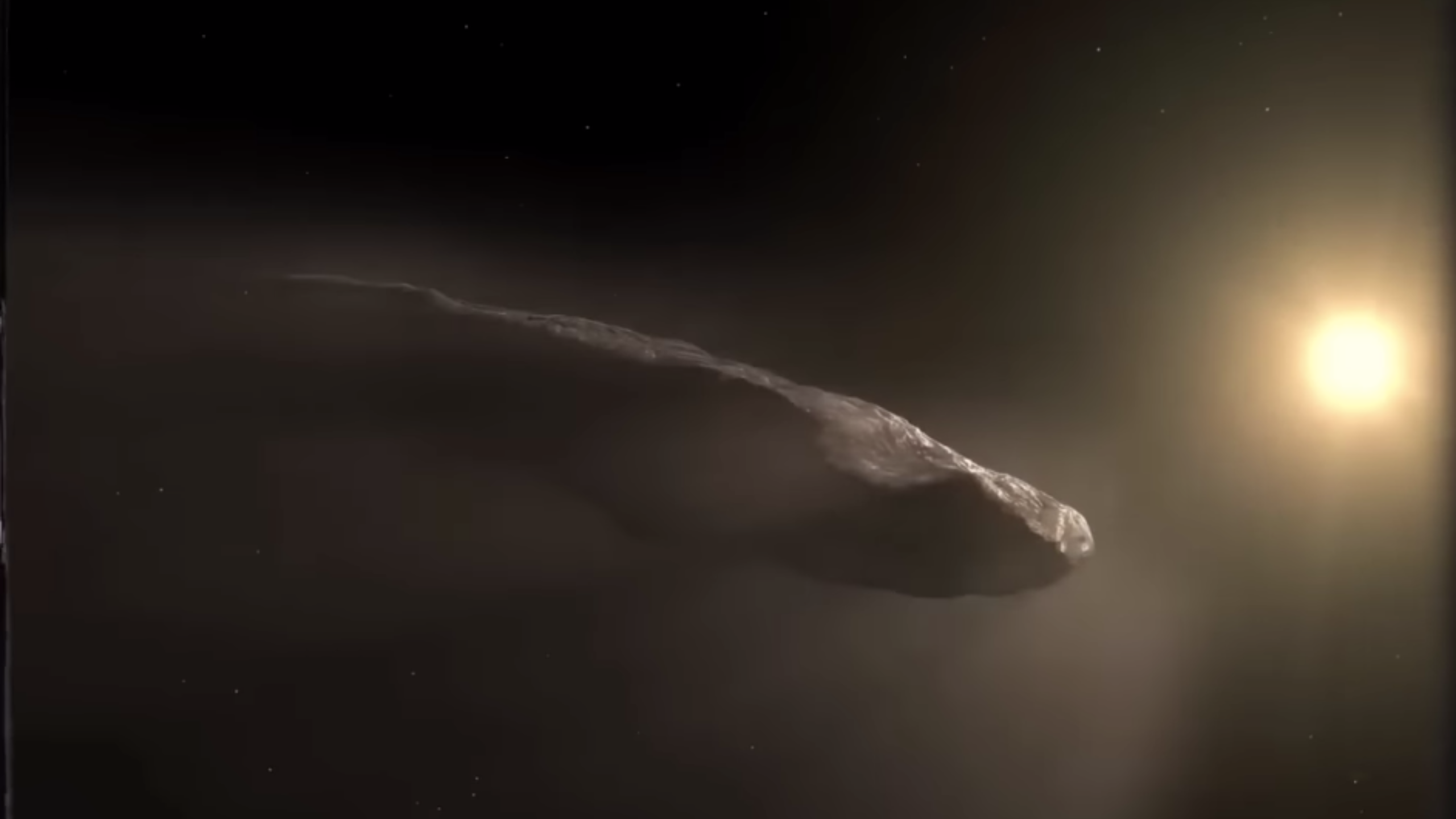
Astronomers are grappling with the unexpected behavior of the interstellar comet 3I/ATLAS, which is exhibiting properties that challenge established cometary physics. This unusual object is producing a sunward-facing plume, known as an “anti-tail,” a phenomenon that has left many in the scientific community questioning existing theories about comet behavior.
Unprecedented Observations from Hubble
Discovered as the third confirmed interstellar visitor, following 1I/’Oumuamua and 2I/Borisov, 3I/ATLAS has recently attracted attention from leading astrophysicists due to its peculiar characteristics. Observations from the Hubble Space Telescope in July 2025 revealed an astonishing structure that is elongated ten times longer than it is wide, contradicting traditional expectations of how comets should behave.
Typically, a comet’s tail is formed by solar radiation pressure pushing particles away from the sun. In contrast, the anti-tail of 3I/ATLAS appears too distinct to merely be an optical illusion, as suggested by some scientists. Avi Loeb from Harvard University has been particularly vocal about this anomaly, emphasizing its implications for understanding the object.
Loeb noted that the sunward glow, observed in high-resolution imaging, is not simply a diffuse cloud but a robust jet structure pointing directly at the sun. This unexpected behavior has prompted various theories, including the possibility that unusually large dust particles or rapidly sublimating ice fragments could account for the observed effects.
Challenging Traditional Theories
The scientific discourse surrounding 3I/ATLAS has intensified, with suggestions that the particles in the anti-tail may be large enough to negate the usual effects of solar radiation pressure. If these particles are indeed substantial, they could lag behind the comet, creating the appearance of a sunward jet.
Measurements indicate that the gas jets typically emitted by natural comets travel at speeds of several hundred metres per second. In stark contrast, the plume from 3I/ATLAS appears to reach velocities on the order of kilometres per second, indicating a more vigorous outflow than what is typically associated with cometary activity. Researchers have estimated the object’s diameter to be as large as 46 kilometres, significantly surpassing the mass of its interstellar predecessors.
Despite losing an estimated two million tons of material between July and October 2025, 3I/ATLAS has maintained its structural integrity, further complicating explanations for its behavior. This resilience raises questions about the mechanisms driving its mass loss and the nature of its composition.
Recent analyses have revealed an unusual chemical composition in the gas plume, with a striking predominance of carbon dioxide (87% by mass) and only about 4% water. This ratio diverges significantly from typical comets, which often contain higher water content.
Moreover, the detected nickel content in the comet has attracted attention, with some studies suggesting a nickel-to-cyanide ratio vastly exceeding that found in known solar system comets. This aspect fuels speculation about potential artificial origins, as nickel-iron alloys are commonly used in industrial applications on Earth.
While scientists strive to explain the transition of 3I/ATLAS from an anti-tail to a traditional tail, some theorists, including Adam Hibberd, have posited that the observed features could point to a more profound explanation, potentially involving extraterrestrial technology. The hypothesis suggests that if the anti-tail functions as a “braking thrust,” it may be indicative of an object executing a gravitational assist maneuver.
The intrigue surrounding 3I/ATLAS continues to grow as researchers monitor its trajectory and characteristics. The ultimate question remains: is this an extraordinary instance of unfamiliar physics, or could it signify a form of engineering beyond current human understanding? As the comet recedes from our Solar System, its enigmatic properties challenge scientists to reconsider the boundaries of our knowledge about celestial bodies.
The ongoing investigation into the nature of 3I/ATLAS serves as a reminder of the mysteries that still exist in the universe, compelling astrophysicists to explore options that extend beyond conventional explanations.