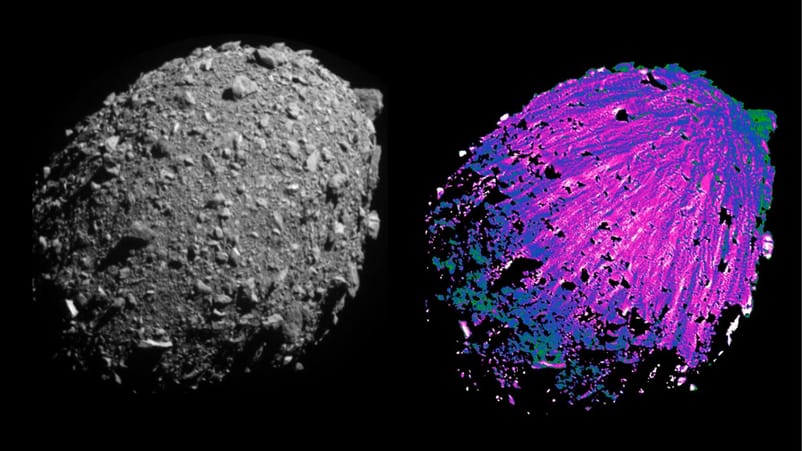
Observations from the NASA spacecraft Double Asteroid Redirection Test (DART) have unveiled an intriguing phenomenon: an active exchange of material between asteroids within binary systems. This finding, derived from images taken in 2022, highlights how about 15 percent of all asteroids, including many Near Earth Asteroids (NEAs), are classified as binary systems.
The DART mission’s primary goal was to impact Dimorphos, a moonlet of the asteroid Didymos, to test planetary defense strategies. However, scientists were surprised to discover fan-shaped streaks across Dimorphos’ surface, indicating gentle yet impactful collisions that lead to the transfer of rock and dust over millions of years. This marks the first direct visual evidence of material naturally moving between asteroids, changing the understanding of their interactions.
Unraveling the Discovery
Initially, researchers suspected that the unusual patterns observed might be due to camera malfunctions or image processing errors. After thorough analysis and image refinement, the streaks remained consistent with low-velocity impacts. To validate their findings, the team employed advanced techniques to eliminate shadows and lighting effects from the images.
The researchers also confirmed the presence of the Yarkovsky-O’Keefe-Radzievskii-Paddak effect, a phenomenon where sunlight causes small asteroids to spin faster, potentially leading to material ejection from their surfaces. Evidence suggests that Dimorphos itself may have formed as a moon from this process, as indicated by the cosmic “snowballs” found on its surface.
Methodology and Validation
The DART spacecraft faced unique challenges during its kinetic impact mission. It approached Dimorphos without altering its lighting or perspective, complicating the resolution of surface features. To authenticate the streaks, scientists traced their origins back to a specific area near the edge of Dimorphos.
Further validation came from laboratory experiments, where researchers simulated asteroid impacts by dropping marbles into sand mixed with painted gravel. High-speed cameras captured the resulting patterns, which mirrored those seen on Dimorphos. Computer simulations of loose dust clumps also produced similar ray-like patterns, reinforcing the study’s conclusions.
The results of this research are detailed in a paper published in The Planetary Science Journal, shedding light on the dynamic processes in binary asteroid systems. This exploration not only enhances the understanding of asteroids but also contributes to the broader knowledge of planetary formation and evolution.
As scientists continue to analyze data from DART, the implications of these findings could reshape future missions aimed at understanding the complexities of our solar system.