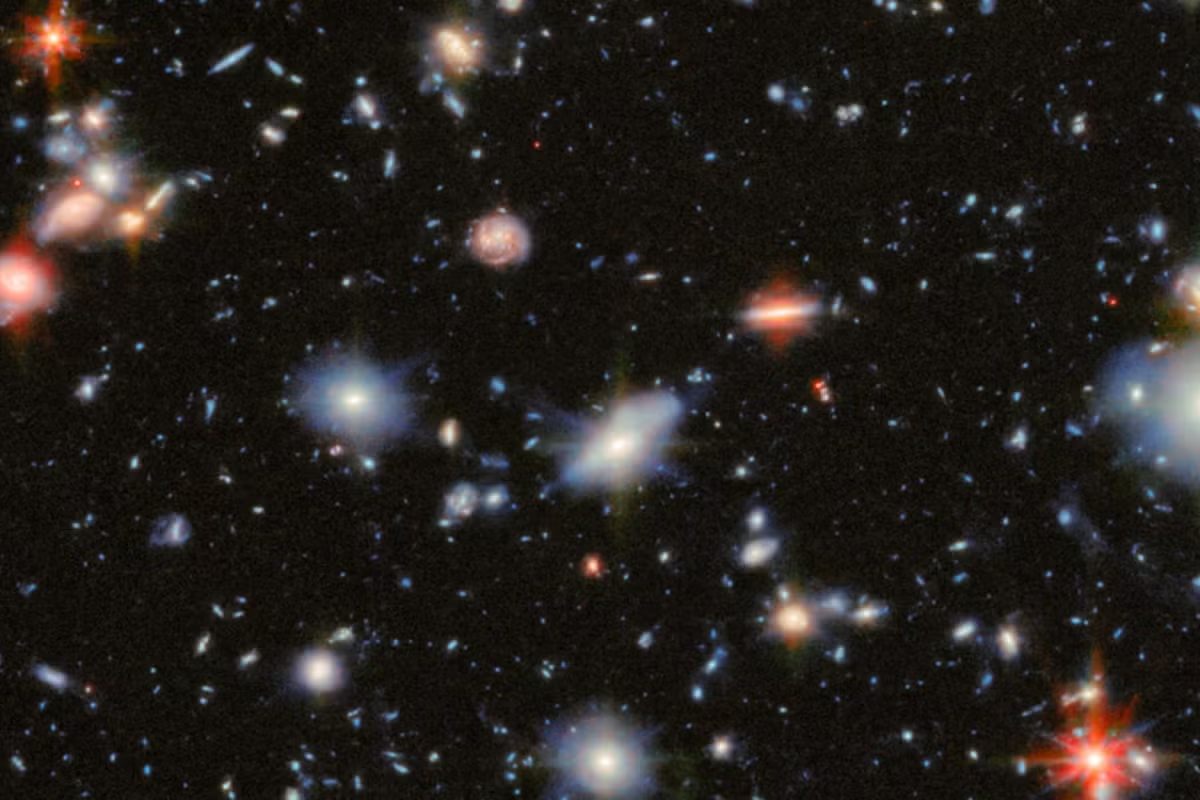
Recent research indicates that the universe may not be as uniform as previously thought. A study published by a team of cosmologists suggests that the universe could possess an asymmetrical structure, challenging the foundational assumptions of the standard cosmological model, known as the Lambda-CDM model. This model relies on the idea that the universe is isotropic, or looks the same in all directions, but new findings raise questions about that premise.
The study highlights a significant issue known as the cosmic dipole anomaly, which presents a fundamental challenge to the widely accepted understanding of the cosmos. The cosmic microwave background (CMB), which is the remnant radiation from the Big Bang, is generally uniform across the sky, showing variations of only one part in one hundred thousand. This uniformity has led scientists to model the universe using what is called the “maximally symmetric” description of space-time as outlined in Albert Einstein’s theory of general relativity.
The Lambda-CDM model, which simplifies Einstein’s complex equations, depends heavily on this symmetric view. However, discrepancies in cosmological data, referred to as “tensions,” have emerged over time, one of the most notable being the Hubble tension. This phenomenon stems from a mismatch between measurements of the universe’s expansion rate from its early days and those from more recent observations.
While the Hubble tension has garnered attention, the cosmic dipole anomaly remains less discussed but is considered even more critical to our understanding of the universe. The CMB dipole anisotropy represents the largest temperature difference observed in the CMB, where one side of the sky is approximately one part in a thousand hotter than the other. Although this variation does not directly contradict the Lambda-CDM model, it creates expectations for corresponding variations in other astronomical observations.
In 1984, astronomers George Ellis and John Baldwin posed a crucial question: if the universe is truly symmetrical, should we not observe similar dipole anisotropies in the distribution of distant astronomical sources such as radio galaxies and quasars? Their inquiry led to what is now known as the Ellis-Baldwin test, which compares variations in the CMB with variations in the distribution of matter in the universe.
Recent data collection has allowed researchers to revisit this test, and the findings indicate a significant inconsistency. The variations in the distribution of matter do not match those seen in the CMB. This conclusion remains robust across different observational methods, whether using terrestrial radio telescopes or satellite imaging in mid-infrared wavelengths.
As a result, the cosmic dipole anomaly has established itself as a major challenge to the Lambda-CDM model, despite being largely overlooked by the astronomical community. The implications of this anomaly are profound; addressing it may require a complete reassessment of the current cosmological framework, moving beyond the FLRW description altogether.
Looking ahead, substantial new data are anticipated from upcoming missions, including the Euclid satellite and the Vera Rubin Observatory, as well as the Square Kilometre Array. These advancements may provide fresh insights into the universe’s structure and composition. Additionally, recent developments in machine learning techniques could play a role in interpreting this data and potentially constructing a new cosmological model.
The findings from this study underscore the dynamic nature of cosmological research. As scientists continue to explore the universe’s mysteries, the consequences of discovering an asymmetric cosmos could reshape our understanding of fundamental physics and the origins of the universe itself. The results of this research could pave the way for a new era in cosmology, prompting a reevaluation of theories that have long been held as standard.