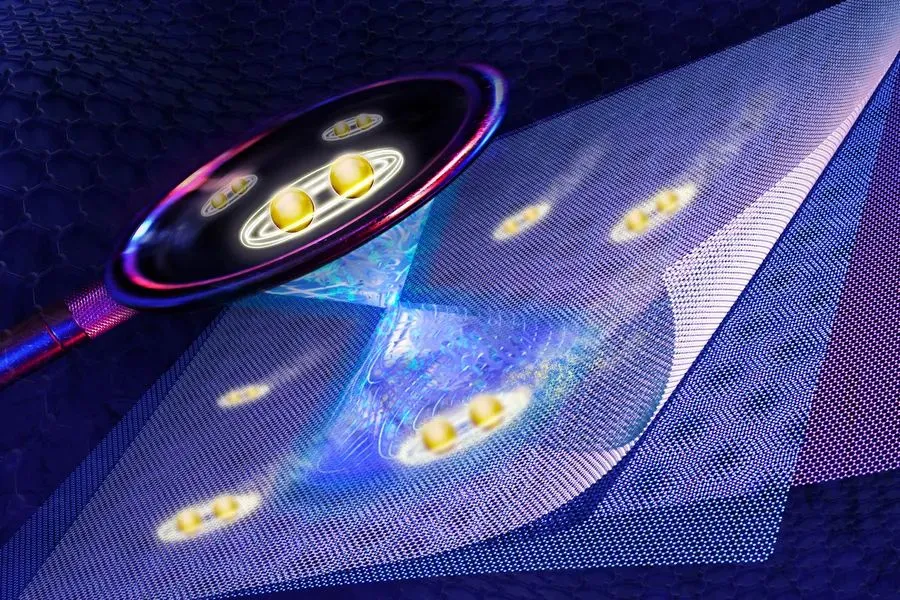
Researchers at the University of California, Santa Barbara, have achieved a significant breakthrough by developing a room-temperature two-dimensional multiferroic metal. This innovative material combines both electric polarization and magnetic order within the same crystal structure, a phenomenon referred to as multiferroicity. The findings, published in late 2023, hold the potential to revolutionize various applications in electronics and data storage.
Multiferroic metals are unique in that they exhibit the ability to couple magnetic and electric properties. This interaction, known as magnetoelectric (ME) coupling, allows electric fields to affect magnetic states. The creation of a two-dimensional multiferroic metal that operates at room temperature marks a pivotal advancement in the field, as previous materials often required extreme conditions to function effectively.
The research team utilized a novel approach to synthesize the multiferroic metal, which involves precise control over its atomic structure. This level of control enables the material to maintain its desirable magnetic and electric properties at ambient temperatures, a critical factor for practical applications.
Implications for Technology and Industry
The implications of this discovery are far-reaching. With the ability to manipulate both electric and magnetic properties in a single material, advancements in data storage and processing technologies are on the horizon. The potential for improved energy efficiency in electronic devices is particularly noteworthy, as multiferroic materials can lead to reduced power consumption.
Moreover, the integration of such materials could enhance the performance of sensors, actuators, and other electronic components. The ability to control magnetic states using electric fields offers exciting prospects for developing next-generation devices that are smaller, faster, and more efficient.
Future Research Directions
As researchers continue to explore the capabilities of multiferroic metals, further studies will focus on optimizing their properties for various applications. Investigations into the scalability of this material for industrial use will be crucial, as will the exploration of other two-dimensional materials that may exhibit similar characteristics.
The work being done at the University of California, Santa Barbara, represents a major step forward in materials science. The research team is optimistic about the future of multiferroic metals and their potential to impact a wide range of fields, from consumer electronics to renewable energy technologies.
In conclusion, the development of a room-temperature two-dimensional multiferroic metal not only advances scientific understanding but also opens new avenues for technological innovation. As researchers delve deeper into this fascinating area, the intersection of magnetism and electricity may soon transform the landscape of modern electronics.