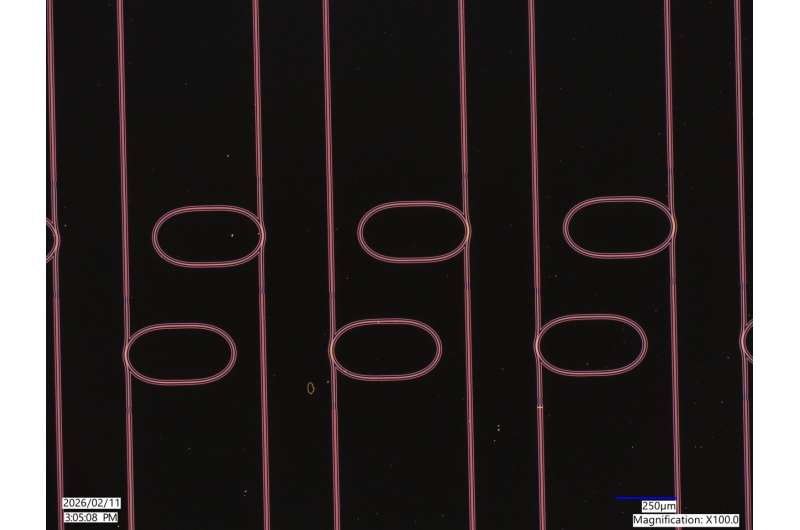
Researchers at the University of Colorado at Boulder have successfully developed highly efficient optical microresonators, a breakthrough that could lead to innovative sensor technologies. These microresonators are tiny devices designed to trap light, allowing it to circulate longer and build intensity, which is essential for various applications in advanced sensing.
The study, published in Applied Physics Letters, highlights the team’s focus on “racetrack” resonators, notable for their elongated shape resembling a running track. By implementing “Euler curves,” a type of smooth curve found in engineering, the researchers minimized bending loss, which is critical for maintaining light intensity within the device. Bright Lu, a doctoral student in electrical and computer engineering and a lead author on the study, emphasized the importance of using less optical power, stating, “One day these microresonators can be adapted for a wide range of sensors from navigation to identifying chemicals.”
Innovative Fabrication Techniques
The microresonators were fabricated at Colorado’s COSINC, utilizing a new electron beam lithography system. This advanced technology offers a controlled environment necessary for working at microscopic scales, crucial for ensuring reliable device performance. Lu pointed out the limitations of traditional lithography, which relies on photons and is restricted by the wavelength of light. In contrast, electron beam lithography achieves sub-nanometer resolution, allowing for precise fabrication of the microresonators.
The research team’s success also hinges on their use of chalcogenides, a family of specialized semiconductor glasses known for their high transparency and nonlinearity. Won Park, a co-advisor on the study and Sheppard Professor of Electrical Engineering, noted, “Our work represents one of the best performing devices using chalcogenides, if not the best.” These materials facilitate the necessary conditions for light to pass through the device at high intensities, enhancing performance.
Testing and Future Applications
Once fabricated, the microresonators underwent rigorous testing led by James Erikson, a physics Ph.D. student. He meticulously aligned lasers with microscopic waveguides to monitor the behavior of light within the device. The researchers searched for “dips” in the transmitted light data, which indicate resonance as photons are trapped. Erikson explained, “The most obvious indicator of device quality is the shape of the resonances, and we want them to be deep and narrow, like a needle piercing through the signal background.”
The results showed promising performance, with sharp resonances indicating that the team had achieved a significant breakthrough in microresonator technology. The implications of this research extend to various fields, including compact microlasers, advanced chemical and biological sensors, and tools for quantum networking.
Lu remarked on the potential impact of these microresonators, stating, “Many photonic components from lasers, modulators and detectors are being developed, and microresonators like ours will help tie all of those pieces together.” The ultimate goal is to create a product that manufacturers can produce in large quantities, potentially revolutionizing sensor technology and its applications in multiple industries.