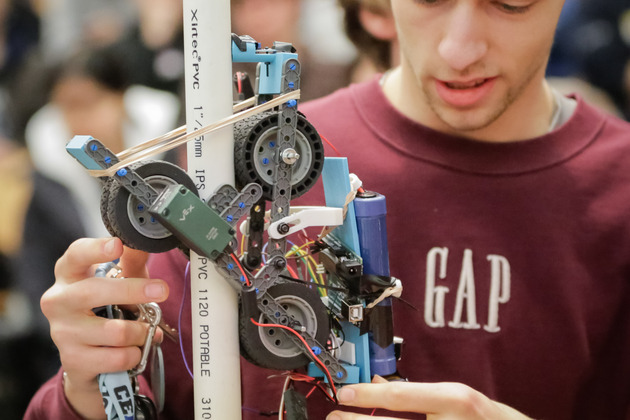
More than 1,000 high school students showcased their scientific skills at the 48th annual Physics Olympics, held on February 28, 2026, at the University of British Columbia in Vancouver, British Columbia. Participants from across the province engaged in various challenges designed to test their understanding of physics principles through hands-on activities.
The event featured a range of competitions, including the creation of innovative projects such as a robotic pole climber. Students collaborated in teams to fine-tune their designs, demonstrating not only their technical skills but also their ability to work under pressure. The atmosphere was charged with excitement as students presented their projects to judges and peers alike.
Celebrating Physics and Innovation
The Physics Olympics serves as an important platform for young minds to explore scientific concepts in a practical setting. Each year, the event draws an increasing number of participants, highlighting the growing interest in STEM (science, technology, engineering, and mathematics) fields among high school students.
According to Xinhua, this year’s event attracted students from various high schools in British Columbia, emphasizing the collaborative spirit of the competition. Teams were not only evaluated on their final projects but also on their problem-solving abilities and teamwork throughout the process.
The organizers expressed pride in the event’s success and its continued ability to inspire future generations of scientists and engineers. “We aim to foster a love for physics and innovation in young students,” said an event spokesperson. “Seeing their enthusiasm and creativity is what makes this event truly special.”
Impact on Future Careers
Participating in the Physics Olympics provides students with invaluable experience that extends beyond the classroom. Many competitors have gone on to pursue careers in engineering, technology, and research, illustrating the event’s long-term impact on their educational trajectories.
As the competition concluded, students left with not only awards and recognition but also a deeper appreciation for physics as a discipline. The mixture of competition and collaboration cultivates skills that are essential in today’s increasingly technology-driven world.
This year’s Physics Olympics will likely remain a memorable experience for all involved, as students continue to push the boundaries of their understanding and creativity in the field of physics.