Researchers from the Institute of Experimental Physics SAS in Košice have made a significant breakthrough in the field of superconductivity. Their study, published on February 6, 2026, in the journal Physical Review Letters, reveals that breaking the inversion symmetry of three-dimensional (3D) crystals can enable them to exhibit properties akin to two-dimensional (2D) Ising superconductivity (IS) without the need for chemical intercalation.
Traditionally, 2D materials like graphene and transition metal dichalcogenides (TMDs) have demonstrated unique quantum phenomena not found in their 3D counterparts. For example, the 2D material NbSe2 showcases remarkable superconductivity, particularly in the presence of strong magnetic fields. This quality has made it a subject of intense study due to its potential applications in advanced technologies, including topological superconductors and quantum computing.
Innovative Approach to Superconductivity
While TMDs have shown extraordinary properties in 2D form, their practical application has been hindered by degradation issues. In contrast, 3D materials are more robust, scalable, and compatible with a broader range of analytical techniques. To harness the advantages of 2D materials in a 3D context, scientists often resort to intercalating functional layers between TMD sheets. This method, while effective, introduces complexity and could lead to extrinsic effects that complicate the results.
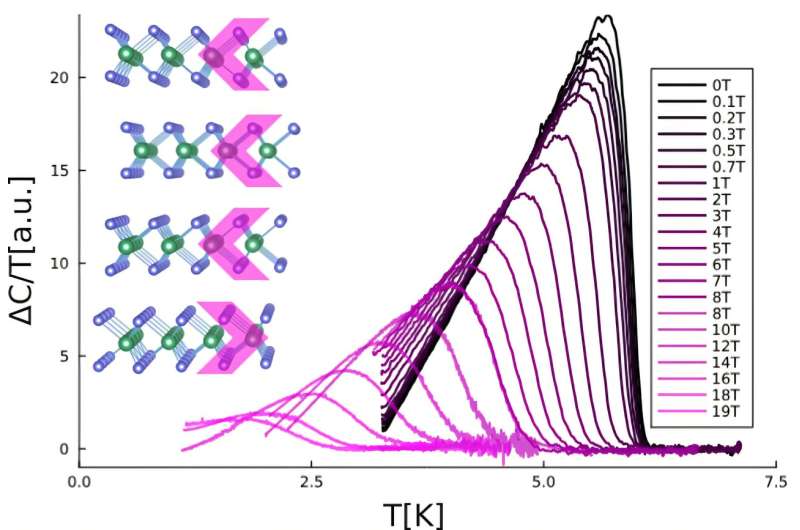
The researchers from Košice propose a more straightforward approach. By simply breaking the inversion symmetry of the crystal lattice in bulk NbSe2, they demonstrated that the material can retain Ising superconductivity without the complications associated with intercalation. Their focus was on the less common 4Ha-NbSe2 polytype, which exhibits broken symmetry and was created at elevated temperatures. The study meticulously confirmed the crystal structure of the sample through various experimental techniques.
Significance of the Findings
Utilizing heat capacity measurements, the researchers established that the superconductivity of the 4Ha-NbSe2 single crystal can withstand magnetic fields nearly three times greater than the Pauli limit. This method offers a clearer understanding of the bulk properties compared to previous studies that relied on transport measurements, which can be influenced by misleading 2D effects.
The results indicate that adjusting the stacking order and symmetry of TMDs—rather than relying solely on chemical composition—can effectively tune their fundamental electronic properties. This breakthrough suggests that symmetry engineering could streamline the design of materials for various applications, providing a robust platform to explore Ising superconductivity further.
“Our findings pave the way for new avenues in materials science, allowing researchers to exploit the unique properties of Ising superconductivity in practical devices,” said Dominik Volavka, one of the lead authors of the study.
This research marks a significant stride in superconductivity, offering potential pathways for innovative technological advancements in areas such as energy storage, quantum computing, and advanced electronics. As scientists continue to explore these findings, the implications for future research and applications in the field are profound.