Researchers at the University of Michigan have made significant advancements in prosthetic technology, showing that implanted electrodes can enhance control of prosthetic hands. This innovative approach could improve the independence and quality of life for individuals who have lost their limbs, particularly those with arm amputations, by providing more reliable and accurate control over their prostheses.
Currently, many upper-limb prostheses are operated using surface electrodes that detect electrical signals from muscles beneath the skin. However, these surface electrodes often suffer from poor signal quality due to factors such as inconsistent placement, changes in limb volume, and interference from sweat and movement. In contrast, implanted electrodes, which are surgically placed within the muscles, promise to deliver superior signal clarity and consistency.
Advantages of Implanted Electrodes
Implanted electrodes can target deeper muscle tissue, resulting in higher signal-to-noise ratios and less susceptibility to everyday variations. Though amputation can remove many of the muscles responsible for hand movement, surgical techniques like the regenerative peripheral nerve interface (RPNI) allow for grafting muscle tissue to nerves in the residual limb. This method not only aids in prosthetic control but also benefits the nerves by providing a target for nerve endings, potentially reducing the risk of painful neuromas and phantom limb pain.
According to Cynthia Chestek, the senior author of the study published in the Journal of Neural Engineering, the integration of electrodes and wireless transmitters during the initial amputation surgery could eliminate the need for additional surgical procedures. “In future, it would also be possible to place electrodes and a wireless transmitter during that same surgery, such that no additional surgeries are required other than the original amputation,” she noted.
Research Findings and Real-World Applications
In their recent study, Chestek and her team explored the effectiveness of implanted electrodes in controlling prosthetic hand and wrist movements. The research involved two individuals with forearm amputations who had EMG electrodes implanted in RPNIs and residual limb muscles. Participants performed various tasks, including mimicking movements on a screen to control a virtual hand.
The results indicated a marked improvement in the control of prosthetic functions using implanted electrodes. For instance, during a controlled experiment, subjects achieved average accuracy rates of 82.1% and 91.2% using implanted electrodes, compared to lower accuracy rates of 77.1% and 81.3% for gelled surface electrodes, and even lower for dry-domed electrodes.
When the participants were standing and mimicking daily activities, the performance of implanted electrodes remained stable, while surface electrodes showed significant declines in accuracy. This robustness is attributed to the higher EMG signal amplitudes and reduced signal fluctuations associated with implanted electrodes.
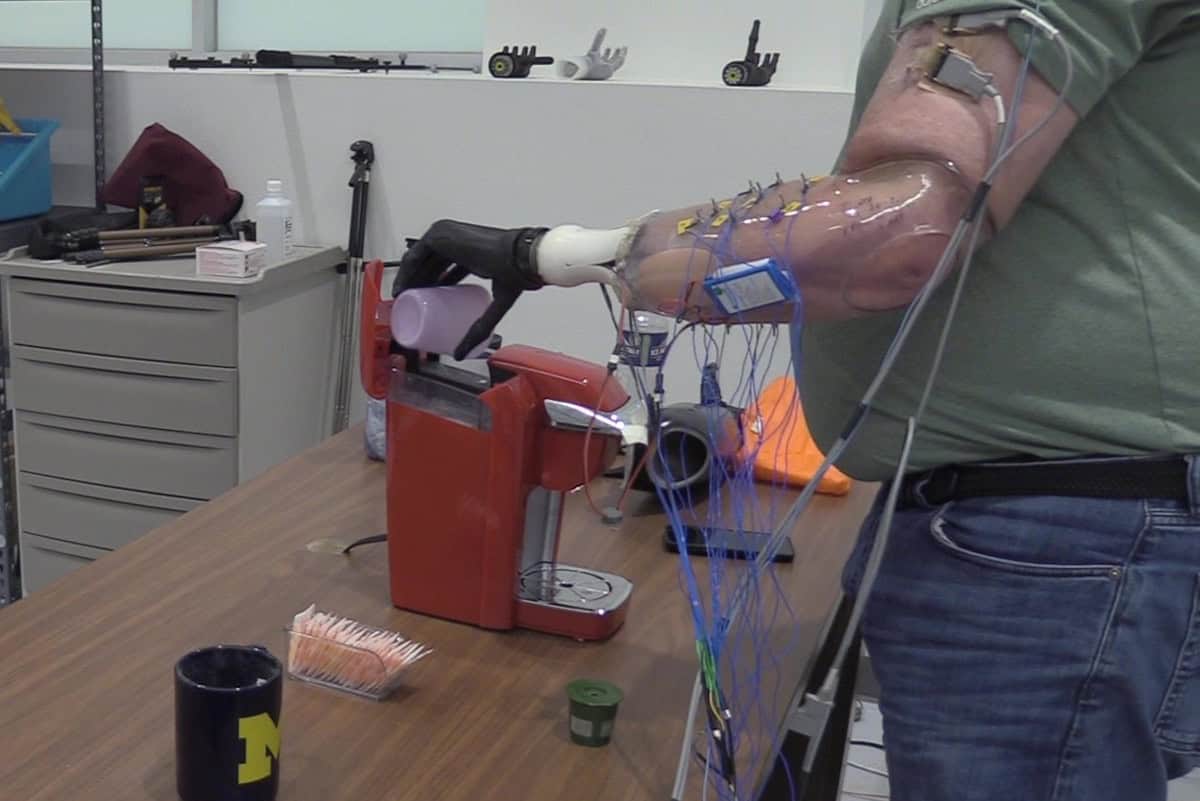
To simulate a typical daily task, one participant undertook the “Coffee Task,” which involved a series of precise movements such as placing a cup in a coffee machine and adding sugar. The task was completed more efficiently using the implanted electrodes, with the participant successfully finishing the task in all attempts, whereas surface electrodes often resulted in hitting the maximum time limit of 150 seconds.
Chestek emphasized the importance of wrist control in enhancing the functionality of prosthetics, as prior studies showed that lacking active wrist movement required users to make large compensatory body movements. “Fortunately, the implantable electrodes provide highly specific and high-amplitude signals, such that we were able to add that wrist movement without losing the ability to classify multiple different grasps,” she stated.
The research points to a promising future for prosthetic technology, with the potential to enable continuous control of individual finger joints, although the timeline for such advancements remains uncertain. As the development of these implantable systems progresses, individuals with limb loss may soon experience enhanced autonomy and improved quality of life.