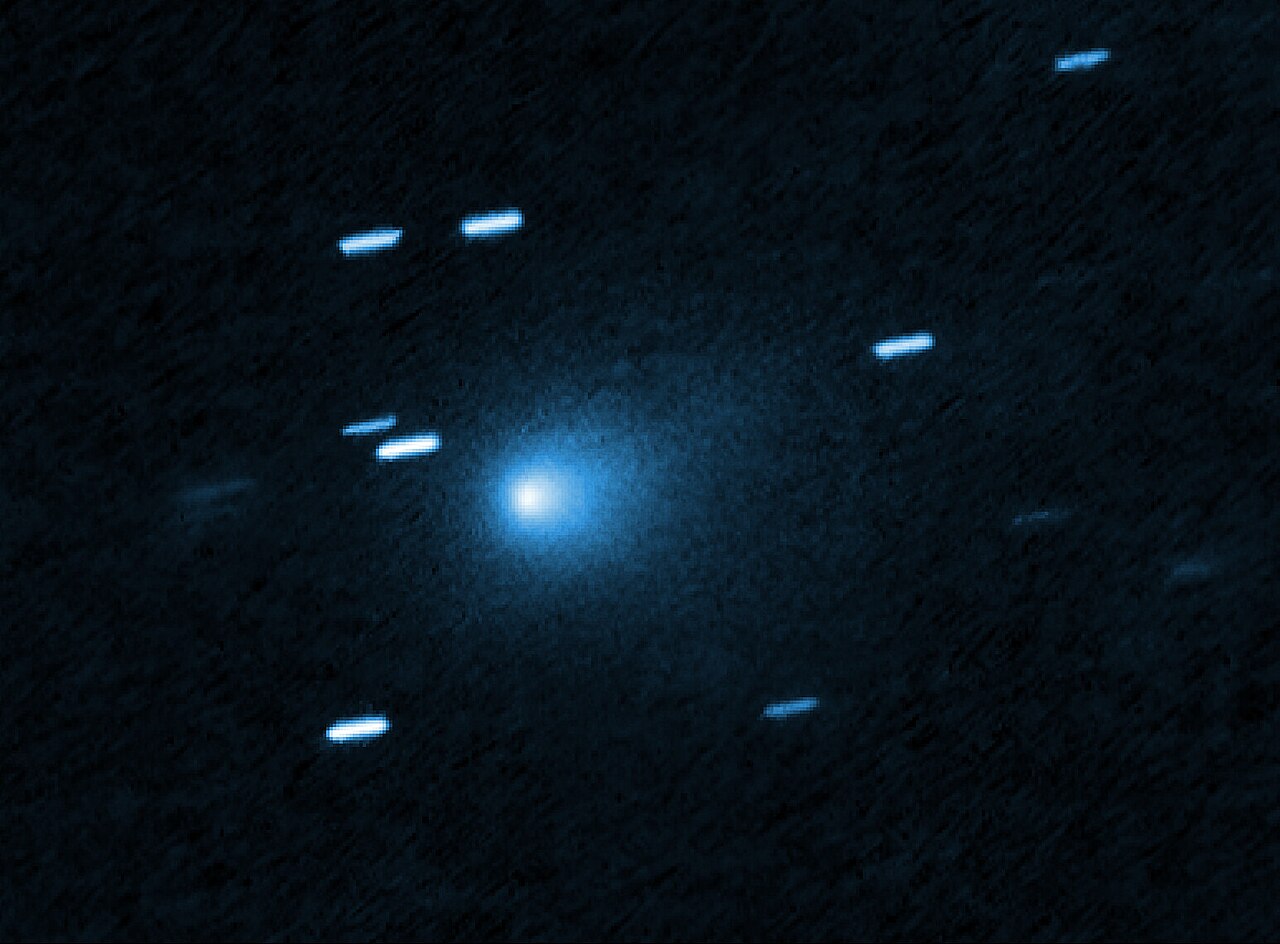
NASA has unveiled new images of the interstellar comet 3I/ATLAS, providing a closer look at this celestial object following its recent close approach to the Sun on October 30, 2023. Captured by the Hubble Space Telescope on November 30, the images confirm that the comet remains active as it travels back into the depths of space. With astronomers preparing for additional viewing opportunities in mid-December, interest in 3I/ATLAS is gaining momentum.
Currently, 3I/ATLAS is moving away from the Sun and is positioned hundreds of millions of kilometres from Earth. Although not visible to the naked eye, it will become more accessible to astronomers equipped with telescopes during upcoming viewing windows in mid to late December. The comet will reach its closest approach to Earth on December 19, 2023, allowing observers to capture a clearer view.
New Observations and Findings
The latest images from Hubble show 3I/ATLAS emitting trails of gas and dust. The stars in the background appear elongated, a result of the telescope tracking the comet’s swift motion during photography. In addition, the European Space Agency (ESA) has also contributed to the observation efforts. The Jupiter Icy Moons Explorer (JUICE) spacecraft captured images of 3I/ATLAS on November 2, soon after the comet’s closest approach to the Sun. An ESA spokesperson noted, “Not only do we clearly see the glowing halo of gas surrounding the comet known as its coma, we also see a hint of two tails. The comet’s ‘plasma tail’—made up of electrically charged gas—stretches out towards the top of the frame.”
Scientists have recently noted that as 3I/ATLAS approaches the Sun, it releases an increased amount of methanol. The Atacama Large Millimetre/Submillimetre Array (ALMA) has recorded significant production of methanol and hydrogen cyanide emitted by the comet. Methanol was detected on four occasions: August 28, September 18, September 22, and October 1. Hydrogen cyanide was found on September 12 and September 15. The ratio of these two chemicals offers critical insights into the origins of the comet.
Implications for Planetary Science
According to Avi Loeb, a physicist at Harvard University, 3I/ATLAS has shown one of the highest methanol-to-hydrogen cyanide ratios recorded, second only to comet C/2016 R2. Such a high methanol ratio suggests that 3I/ATLAS may have formed in an exceptionally cold, carbon-rich environment, distinct from those that created most comets within our Solar System. This unique chemical signature allows astronomers to study the specific conditions of another star’s protoplanetary disk.
By analysing the outgassing of 3I/ATLAS, researchers can conduct what is effectively remote geology on a celestial body from another part of the galaxy. This research could significantly enhance our understanding of planetary system formation, providing valuable data about the processes that shape our universe.
As the viewing opportunities approach, astronomers and enthusiasts alike are preparing to engage with this fascinating comet. The scientific community is eager to learn more about the mysteries of 3I/ATLAS, as its journey continues to unfold across the cosmos.