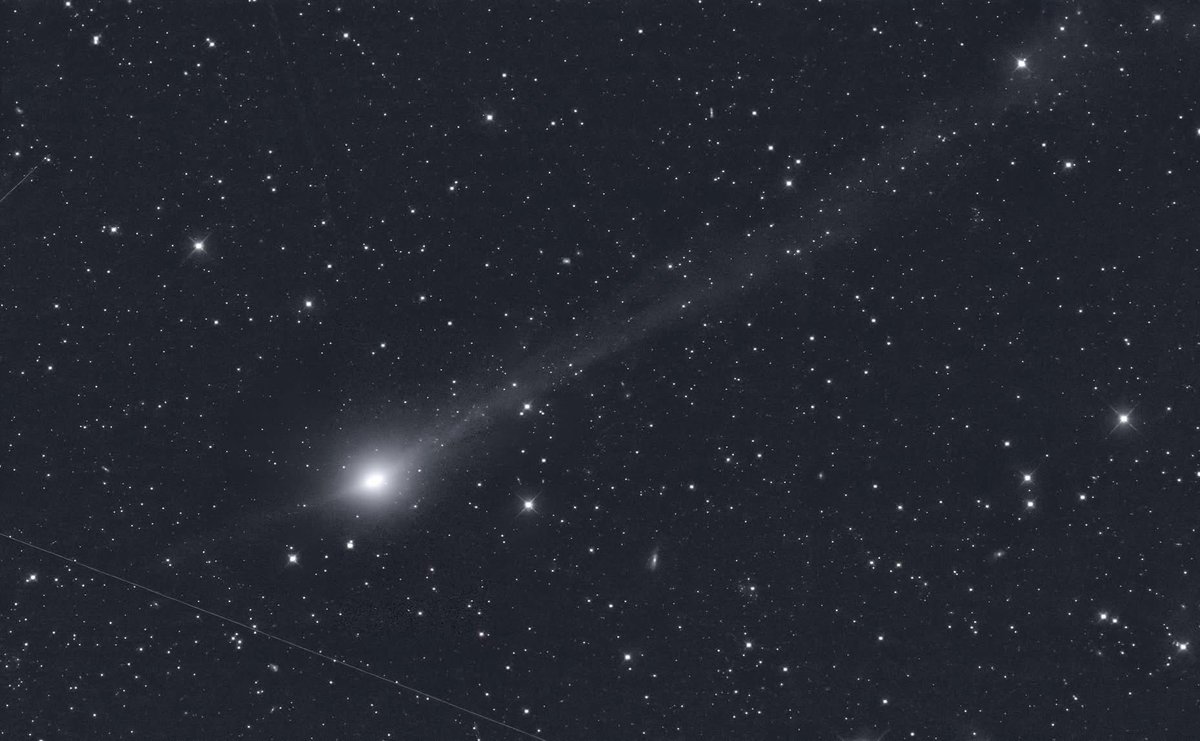
The interstellar object known as 3I/ATLAS has been identified as a source of human-made radio noise rather than signals from extraterrestrial technology. Discovered on July 1, 2025, by the Asteroid Terrestrial-impact Last Alert System (ATLAS) in Hawaii, 3I/ATLAS captivated scientists and the public alike, leading to intense speculation regarding its origins and potential technological capabilities.
When first detected, 3I/ATLAS was confirmed to be unbound to the Sun, indicating it had traveled from outside our Solar System. Notable figures in the scientific community, such as Harvard astrophysicist Avi Loeb, raised the possibility that interstellar visitors could be technological probes. This sparked a debate within the scientific community about whether claims of alien spacecraft risked overshadowing critical scientific data.
As 3I/ATLAS approached the inner Solar System, it never came closer than approximately 270 million kilometers from Earth, a distance that allowed powerful radio telescopes to monitor its activity. The Breakthrough Listen initiative, dedicated to searching for signs of intelligent extraterrestrial communications, utilized this opportunity to conduct a focused search for potential ‘technosignatures’—radio signals that may indicate artificial origins.
On December 18, 2025, just before the comet’s closest approach, the Green Bank Telescope in West Virginia was directed at 3I/ATLAS to sweep frequencies between 1 and 12 gigahertz, including the ‘water hole,’ a quiet segment of the radio spectrum. The Allen Telescope Array in California and other observatories collaborated in this effort, creating one of the most detailed surveys ever performed on an interstellar object.
While the observing campaign detected nine radio signals that initially appeared promising, further analysis revealed they were not extraterrestrial in origin. Each signal coincided with moments when the telescope was not directly aimed at 3I/ATLAS, indicating interference from human technology. Likely sources of this interference included satellites, aircraft, and ground-based communication systems that frequently contaminate deep-space observations.
In a preliminary paper pending peer review, researchers concluded bluntly that they found “no credible detections of narrowband radio technosignatures originating from 3I/ATLAS.” They also noted that other survey teams in 2025, employing various telescopes and frequency ranges, reported similar results, also yielding no signs of alien technology.
While the lack of evidence for extraterrestrial signals may seem disappointing, researchers emphasize that these non-detections help refine future searches for interstellar communications. With only three known interstellar objects to date, including 3I/ATLAS, the current data remains insufficient to categorically rule out the existence of advanced probes.
In parallel to the technosignature search, a separate group of scientists investigated how 3I/ATLAS interacted with the Sun’s gravitational influence. They studied its non-gravitational acceleration, which occurs when sunlight warms the comet, causing ice to evaporate and create jets that act like natural propulsion. This analysis, which involved data from various observatories and spacecraft, indicated that the nucleus of 3I/ATLAS is approximately one kilometer in diameter, typical for familiar Solar System comets.
The researchers found no unusual features that might suggest artificial structures, concluding that “3I/ATLAS exhibits mostly typical cometary characteristics.” They stated, “There is currently no evidence to suggest that interstellar objects are anything other than natural astrophysical entities.”
As 3I/ATLAS continues its journey beyond the reach of Earth, it serves as a reminder that natural phenomena can be intriguing without the need for extraterrestrial involvement. The effort poured into studying this fleeting visitor illustrates the seriousness with which astronomers approach the search for signs of other civilizations, highlighting that every result—whether positive or negative—refines our understanding and methodologies for future inquiries.
Looking ahead, the experience gained from this search will aid researchers as they prepare for the next interstellar object that ventures close enough for observation. If humanity desires clearer answers from future celestial visitors, ongoing support for ambitious projects like Breakthrough Listen, improved protections for the radio spectrum, and sustained public interest in rigorous, data-driven astronomy will be crucial.