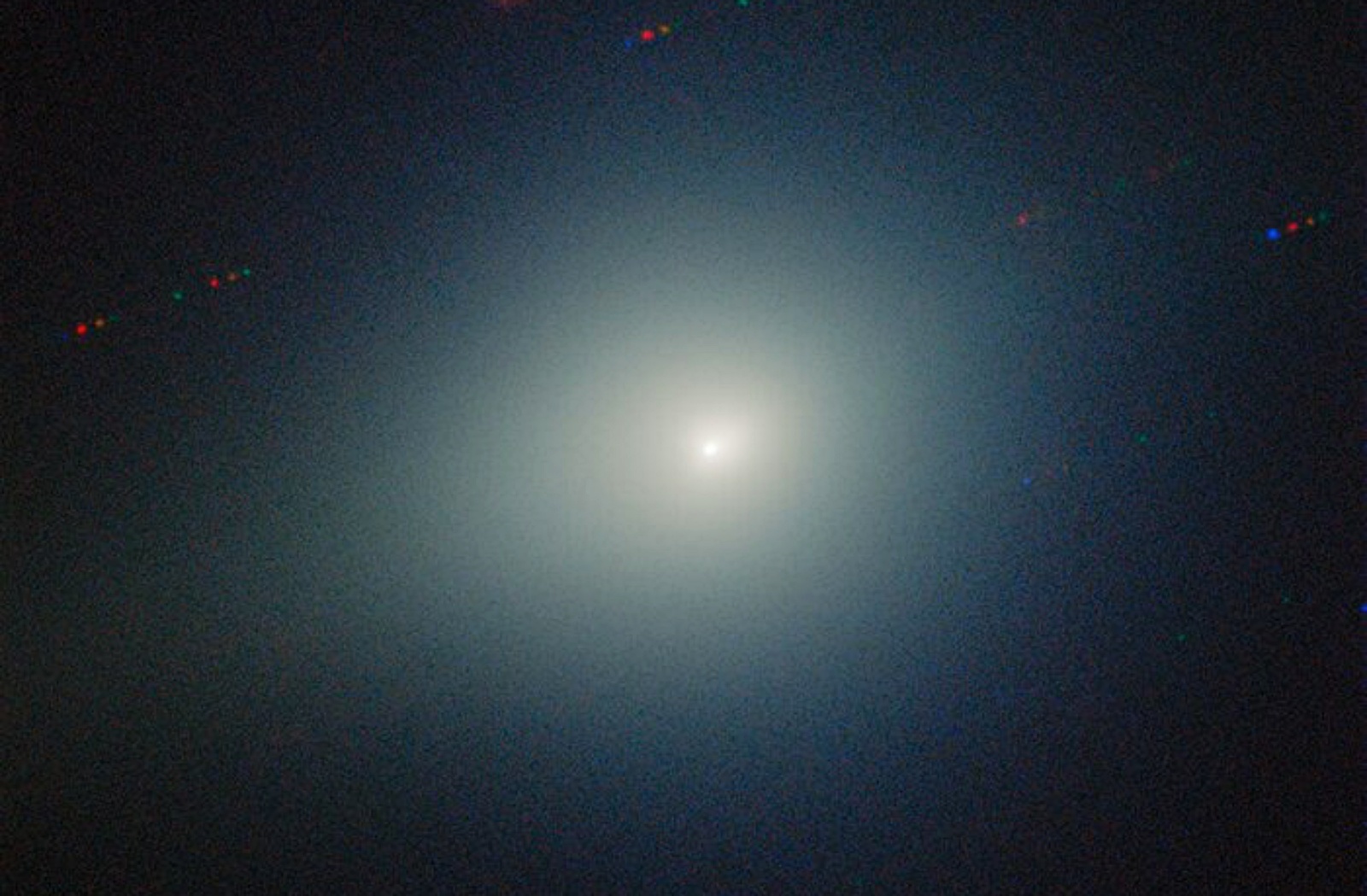
A remarkable celestial event is unfolding as the interstellar object 3I/ATLAS approaches Earth, displaying a striking greenish glow. This unusual phenomenon has sparked interest among astronomers and raised questions regarding the object’s true nature as it makes its closest pass to our planet.
As 3I/ATLAS speeds through the inner Solar System, scientists from the National Aeronautics and Space Administration (NASA) have attributed the color change to typical cometary chemistry. However, this explanation has led to further speculation among some observers who argue that the object exhibits characteristics not usually seen in natural comets, prompting theories about its possible alien origins.
NASA has undertaken an extensive observational campaign to gather data on 3I/ATLAS, employing advanced tools such as the Hubble Space Telescope and the James Webb Space Telescope. These efforts aim to study the object’s composition, determine its exact trajectory, and assess its distance within our Solar System.
Scientific Investigations and Anomalies
Despite NASA’s conclusion that 3I/ATLAS is merely a comet with no threat to Earth, some scientists urge caution. Dr. Avi Loeb, a Harvard astrophysicist, cautions against jumping to conclusions about the object’s nature. In a recent post, he suggested that anomalies observed in 3I/ATLAS could indicate advanced technology rather than a natural phenomenon. He stated, “If the hypothesis about a technological artefact ends up being correct, then there are two possible implications: first that the intentions of 3I/ATLAS are entirely benign, and second that they are malign.”
The excitement surrounding 3I/ATLAS has intensified as it nears its closest approach to Earth, scheduled for December 2023. Following a recent observation from Hawaii, scientists captured new data revealing a significant color shift in the comet after its perihelion, or closest approach to the Sun. The object was observed near Zaniah, a prominent star in the Virgo constellation, where its faint greenish glow was documented.
This color change raises intriguing questions about whether it might be linked to extraterrestrial signals. Scientists at the Noir Lab have dismissed the idea of an alien connection, attributing the glow to gases evaporating in the comet’s coma as it heats up. The light emitted is primarily produced by diatomic carbon (C2), a reactive molecule formed from two carbon atoms that naturally emits light in green wavelengths.
Celestial Events and Public Interest
As 3I/ATLAS approaches, it coincides with other notable astronomical events, including this month’s Geminid meteor shower and a conjunction between Jupiter and the Moon. The closest approach of 3I/ATLAS to Earth is expected to occur at approximately 170 million miles away, providing a unique opportunity for skywatchers and scientists alike.
With the approaching flyby igniting curiosity among the public, many are keen to witness this interstellar visitor. The combination of its unusual color shift and the ongoing debate about its nature highlights the intersection of scientific inquiry and public fascination with the cosmos. As the date draws closer, both astronomers and enthusiasts will be watching the skies, eager to see what 3I/ATLAS reveals as it makes its historic pass by Earth.