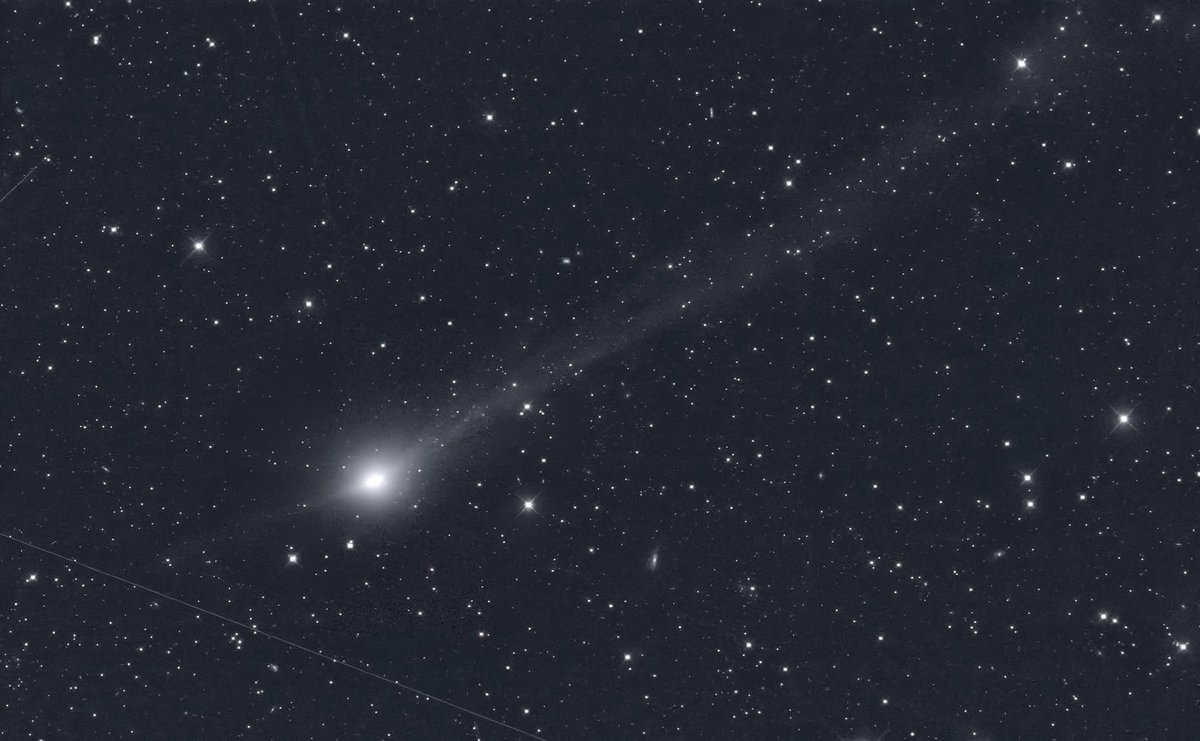
The interstellar comet 3I/ATLAS has once again altered its trajectory, raising fresh concerns and curiosity among scientists. Discovered on July 1, 2025, by the ATLAS telescope network in Chile, this comet has fascinated astronomers not only for its unusual interstellar origins but also for its unpredictable path. The latest deviation from its predicted course has prompted a reassessment of the behaviors exhibited by interstellar objects as they enter our solar system.
While NASA and international observatories have confirmed that 3I/ATLAS poses no immediate threat to Earth, its erratic movements offer a unique opportunity for researchers to study the complexities of interstellar visitors. Officially designated C/2025 N1, 3I/ATLAS is only the third confirmed interstellar object observed, following ‘Oumuamua in 2017 and 2I/Borisov in 2019.
Trajectory Changes and Observations
The comet underwent a significant course shift observed in late December 2025, as astronomers noted its deviation from the anticipated path. This change was confirmed by images captured by the Gemini North observatory after the comet reemerged from behind the Sun. On October 30, 2025, 3I/ATLAS reached its closest approach to the Sun, known as perihelion, and safely passed Earth on December 19, 2025, at a distance of approximately 1.8 astronomical units (about 168–270 million miles).
The distance ensured that there was no danger to Earth, yet the comet’s unpredictable shifts have captured the attention of both scientists and the public alike. Researchers have identified outgassing—the release of gas and dust as the comet warms—as the primary factor influencing these sudden changes. This process can subtly affect the comet’s velocity and trajectory, complicating predictions.
“Each new observation helps us better understand the complex forces acting on interstellar objects,” the USA Herald reports.
Global Collaboration and Scientific Significance
Astronomers from around the globe are working collaboratively to monitor 3I/ATLAS in real time. They employ various techniques, including telescopic imaging, spectroscopy, and computational modeling, to capture the nuances of the comet’s behavior. This international initiative underscores the value of shared data in understanding unpredictable celestial phenomena.
Studying 3I/ATLAS not only enhances our knowledge of interstellar comets but also sheds light on the conditions and materials found in distant star systems. Such insights could be pivotal in unraveling the formation processes of our own solar system and the dynamics of other planetary systems.
While 3I/ATLAS is not a direct threat, its unexpected movements serve as a reminder of the unpredictability inherent in space. Gaining a deeper understanding of the forces that shape its trajectory is essential for scientific discovery and future planetary defense strategies. Researchers hope that lessons learned from this comet will improve preparations for potential encounters with other interstellar visitors, some of which may come closer to Earth.
The behavior of 3I/ATLAS highlights the limitations of our current predictive models, emphasizes the importance of global scientific collaboration, and demonstrates the exciting potential of studying interstellar objects. As investigations continue, the astronomical community remains vigilant, eager to uncover the secrets of this remarkable interstellar traveler.