The discovery of the interstellar comet 3I/ATLAS on July 1, 2025, has sparked a wave of speculation regarding its possible extraterrestrial origins. During a recent appearance on the Joe Rogan Experience, Tesla CEO Elon Musk shared his thoughts on the object, which has captured the imagination of both scientists and the public alike. As the third confirmed interstellar visitor after 1I/’Oumuamua and 2I/Borisov, 3I/ATLAS exhibits unusual characteristics that have intensified discussions about its nature.
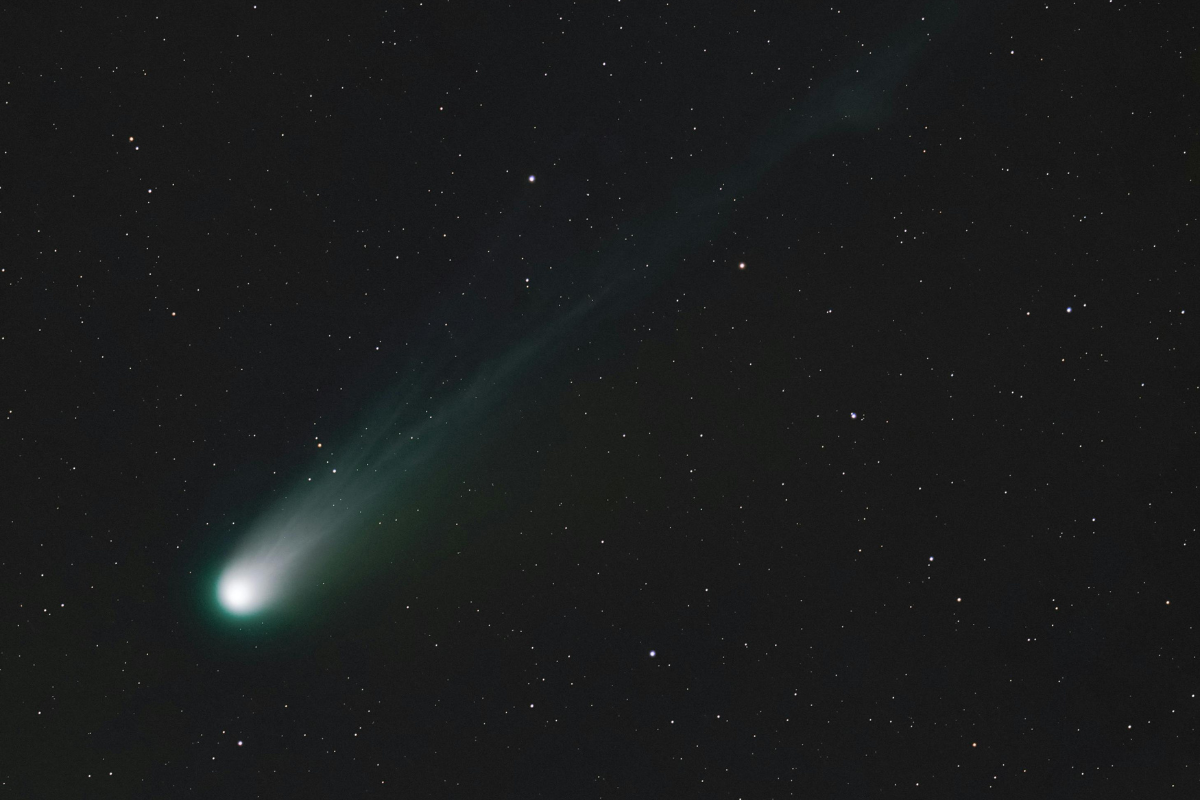
Astronomers at the Asteroid Terrestrial-impact Last Alert System first identified 3I/ATLAS hurtling through our Solar System. This object, roughly the size of Manhattan, is notable for its anomalous acceleration and lack of a visible tail, which have led some, including Harvard astrophysicist Avi Loeb, to suggest that it might be an artificial construct. According to Loeb, the non-gravitational accelerations observed in the comet could indicate an extraterrestrial origin.
On October 30, 2025, 3I/ATLAS will reach its perihelion, as it travels on a trajectory that will bring it closest to Earth on December 19, 2025, at a distance of approximately 270 million kilometers. As the comet approaches, it will be closely monitored by telescopes around the world. Its current velocity stands at 57 km/s, with a dust cross-section measuring 230 km². Recent images from NASA’s Hubble Space Telescope have also revealed a developing ion tail, though a detected radio signal associated with the comet has since been confirmed as a natural phenomenon.
In the podcast, Musk expressed skepticism about the idea that 3I/ATLAS is an alien spacecraft. “No, there are definitely comets and asteroids which are primarily made of nickel,” he stated, countering claims of artificial origins. Nonetheless, he acknowledged the object’s peculiarities, saying, “It could be alien; I don’t know.” His comments ignited renewed interest and speculation surrounding the comet, particularly regarding its potential risks.
Musk further warned of the possible catastrophic consequences of a collision with Earth. “It would obliterate a continent type of thing,” he cautioned, adding, “Maybe worse. Probably kill most of human life. If not all of us.” These stark statements have resonated widely, amplifying public discourse on the implications of interstellar objects entering our Solar System.
The duality of wonder and concern surrounding 3I/ATLAS reflects the broader fascination with cosmic phenomena. While some enthusiasts cling to the hope of discovering extraterrestrial life, experts emphasize the importance of grounding such discussions in scientific evidence. As noted by various researchers, “Despite claims that 3I/ATLAS may be an alien spaceship, a growing body of observations reveals it’s a natural comet.”
The ongoing dialogue about 3I/ATLAS illustrates the tension between imaginative speculation and empirical observation in the field of astronomy. As the comet nears its closest approach to Earth, scientists are calling for enhanced detection systems to monitor future interstellar intruders and deepen our understanding of such celestial bodies.
With high-resolution images expected from NASA as 3I/ATLAS approaches, the scientific community remains eager for insights that could clarify the comet’s origins. Whether it ultimately serves as a harbinger of alien contact or a mere icy remnant of the cosmos, the discovery reignites humanity’s quest to comprehend the universe and prompts a call for vigilance against potential interstellar threats.