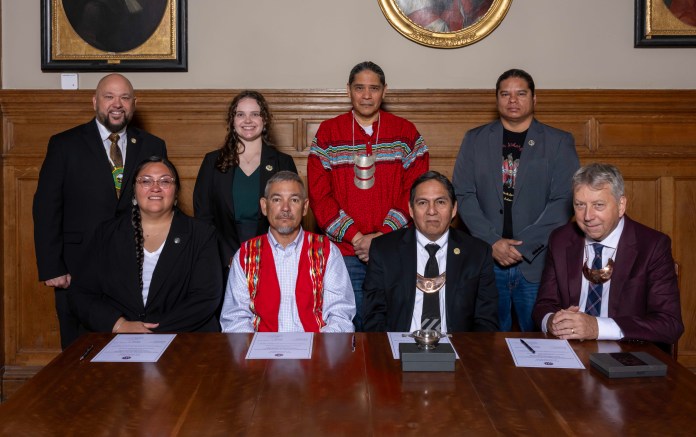
The University of Edinburgh has returned six skulls of Native American individuals, previously used in discredited phrenology studies, to the Muscogee Nation in the United States. This significant repatriation follows a summit between university officials and tribal leaders, marking a step forward in addressing historical injustices related to colonialism and racism.
The skulls will be shipped to Oklahoma, where the Muscogee Nation is now based after being forcibly relocated due to the Indian Removal Act. This act, which occurred in the 1830s, is widely regarded as an act of state-sanctioned ethnic cleansing, leading to the suffering and death of many during the forced migration known as the Trail of Tears.
Acquired from the Edinburgh Phrenological Society—an organization that promoted the discredited theory of phrenology—the skulls were part of a collection that raised ethical concerns about their use. Phrenology, which inaccurately suggested that a person’s character and intellect could be determined by the shape of their skull, was famously employed by white Europeans to justify colonialism and racial superiority over various ethnic groups.
The Edinburgh Phrenological Society obtained the skulls before 1858, and after its closure in 1886, the collection was transferred to the university’s Department of Anatomy. Although phrenology has never been part of the university’s curriculum, approximately 1,000 skulls remain in its collection today.
Efforts to repatriate these remains have intensified in recent years, with the university acknowledging its uncomfortable legacy linked to slavery and colonialism. Professor Tom Gillingwater, chair of Anatomy at the University of Edinburgh, emphasized the importance of addressing the history of the university’s collections. He stated, “Caring for and addressing the history of our collections is a key responsibility for the university, and repatriations play a central role in this work.”
The return of these skulls has been met with gratitude from the Muscogee Nation. Principal Chief David Hill expressed the significance of this gesture, noting, “We have been blessed with a tremendous honour and respect from our friends at the University of Edinburgh with the return of these ancestral remains.” He highlighted the irony in needing to travel over 4,000 miles for dignity and respect that should be afforded at home, calling for other institutions to follow suit in addressing similar injustices.
The Muscogee Nation, one of the largest self-governing tribal nations in the U.S. with approximately 103,000 members, has a rich history that predates European contact in 1539. Known for their agricultural practices and extensive trade networks, they faced devastating consequences following their forced relocation.
In recent years, the University of Edinburgh has also repatriated remains from other indigenous communities, including the skulls of three Ainu people to Japan in 2025. Peter Mathieson, principal and vice-chancellor of the university, reiterated the institution’s commitment to confronting its historical ties to racism and inequality, stating, “Repatriations are an important part of our work to confront our history.”
As the university continues its repatriation efforts, it has been reported that it is in confidential discussions with African leaders regarding the return of 185 skulls taken from Africa under coercive circumstances. This ongoing dialogue reflects a broader movement in academic institutions to rectify past wrongs and foster meaningful relationships with indigenous communities worldwide.