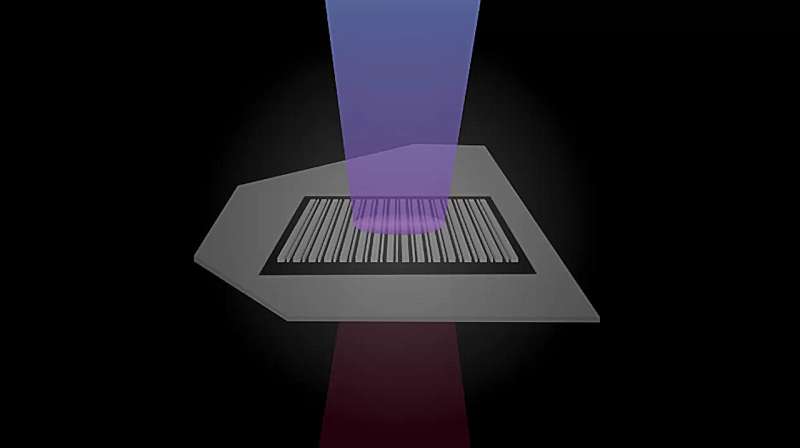
Researchers at Columbia University have made significant strides in nonlinear optics by developing innovative metasurfaces integrated with ultrathin crystalline materials. In a paper published in Nature Photonics in October, the team led by Jim Schuck, a professor of mechanical engineering, detailed their approach, achieving a remarkable reduction in size for nonlinear optical platforms.
The breakthrough involves creating metasurfaces—artificial geometries etched into 2D materials—that enhance nonlinear optical effects at a nanoscale level. Previously, the Schuck lab focused on generating entangled photon pairs using a crystalline device measuring just 3.4 micrometers thick. Now, they have reduced the thickness of these platforms to merely 160 nanometers, opening new avenues for emerging quantum technologies.
Advancing Quantum Technologies
The study centers on transition metal dichalcogenides (TMDs), which can be peeled into atom-thin layers. These materials exhibit substantial nonlinearity but previously lacked the efficiency needed to generate new photon frequencies effectively. Chiara Trovatello, the corresponding author of the study and an assistant professor at Politecnico di Milano, emphasized the importance of size in quantum technologies. Current state-of-the-art qubit sources require extensive space, often taking up entire rooms, making scalability a critical challenge.
In their earlier research, the team utilized a technique called periodic poling to generate photons capable of powering qubits. By layering molybdenum disulfide in alternating orientations, they optimized the optical output. This new study introduces a complementary platform that enhances photon generation by employing highly tunable, etched metasurfaces.
Innovative Nanofabrication Techniques
Ph.D. student Zhi Hao Peng, the lead author of the new paper, developed a nanofabrication technique that involves etching repeating lines onto a flake of molybdenum disulfide. This innovative design significantly boosts the nonlinear effects, achieving an enhancement of nearly 150 times in second-harmonic generation compared to unpatterned samples. In second-harmonic generation, two photons merge into one, resulting in a photon with double the frequency and half the wavelength of the originals.
The simplicity of Peng’s method, which requires fewer steps and is more cost-effective than traditional approaches, represents a notable advancement in the field. Jim Schuck highlighted the challenges posed by traditional nonlinear crystals, which can be brittle and difficult to fabricate. With Peng’s technique, researchers can create complex patterns using standard cleanroom etching technologies.
The collaboration extended beyond Columbia, with theoretical input from Andrea Alu of the CUNY Advanced Science Research Center and his former postdoctoral researcher, Michele Cortufo. They helped determine the optimal metasurface pattern needed to enhance the nonlinear response of TMDs effectively.
The findings suggest that simple modifications to the crystal structure can yield significant improvements. Rather than working with flat flakes, the team patterned them with a periodic arrangement of lines featuring alternating widths. This innovative approach distinguishes their work in the rapidly evolving field of photonics.
As research in metasurfaces continues to advance, the potential applications are promising. Alu noted that this work demonstrates how engineered nonlocalities in metasurfaces can unlock unprecedented nonlinear efficiencies when combined with 2D materials. The light produced operates at telecommunications-range wavelengths, which should facilitate integration with existing networks and devices.
Looking ahead, Jim Schuck expressed optimism regarding the future of on-chip quantum photonics. With their compact design, the team is paving the way for more accessible quantum technologies. The efficient generation of entangled photons at a nanometer scale could revolutionize the field, bringing quantum computing closer to practical application.
The research contributes to the broader understanding of nonlinear optics and highlights the importance of integrating advanced materials to achieve significant technological advancements. Further studies will explore the reverse process of splitting a single photon into two entangled photons, potentially leading to new breakthroughs in quantum information systems.
For more detailed insights, the full article can be found in Nature Photonics under the title “3R-stacked transition metal dichalcogenide non-local metasurface for efficient second-harmonic generation.”