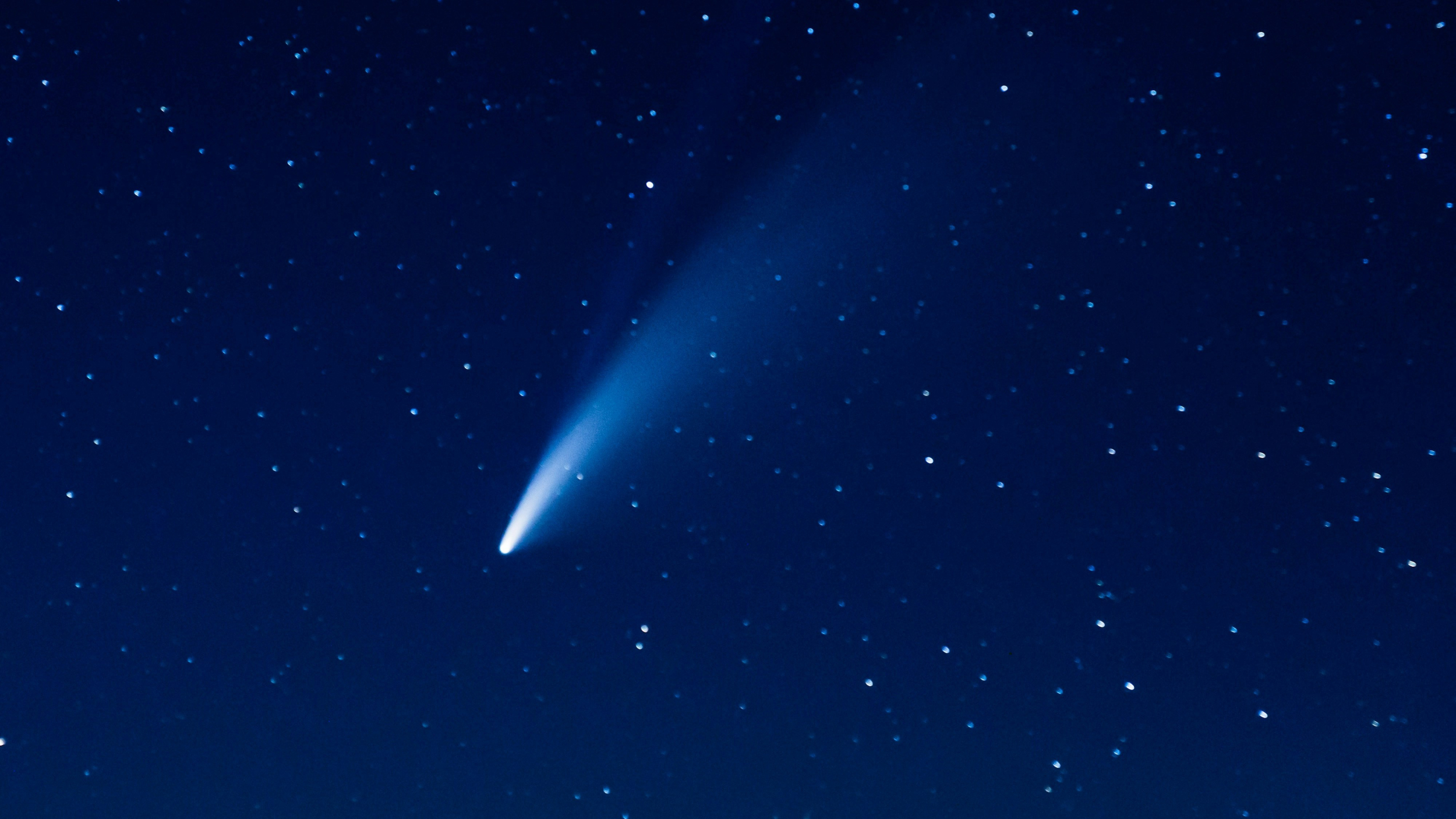
Comet 3I/ATLAS is attracting significant attention from astronomers due to its unusual behavior as it exits the inner solar system. Observations have revealed striking features, including a dust stream pointing directly toward the Sun—a phenomenon that has sparked speculation regarding its origins. This peculiar comet is now a key focus for scientists studying interstellar objects.
One of the most remarkable characteristics of 3I/ATLAS is its pronounced ‘anti-tail.’ Unlike typical comets, which have tails that extend away from the Sun, the anti-tail of 3I/ATLAS stretches approximately 1,000,000 km in the direction of solar radiation. This feature has raised questions among researchers, as anti-tails are rare but not unheard of. They can occur when the Earth’s perspective aligns with a thin layer of dust in the comet’s orbit, creating the illusion of a tail pointing the opposite way.
In addition to its anti-tail, astronomers have observed intermittent jet-like structures that shift position over time. These jets do not remain static, suggesting that the comet’s nucleus may be rotating and periodically venting material. A detailed observation campaign conducted with the Two-metre Twin Telescope at Teide Observatory in Tenerife tracked 3I/ATLAS over 37 nights. Researchers noted a precessional pattern with a periodicity of 7 hours 45 minutes, inferring a rotational period of approximately 15 hours 30 minutes for the nucleus.
Comet 3I/ATLAS is only the third confirmed interstellar object to pass through our solar system, following 1I/’Oumuamua in 2017 and 2I/Borisov in 2019. Each of these objects has provided unique insights into the formation and characteristics of bodies originating from outside our solar system. While Borisov resembled traditional comets, ‘Oumuamua generated debate due to its unusual shape and non-gravitational acceleration.
The detailed observations of 3I/ATLAS may yield one of the most comprehensive studies of an interstellar visitor’s rotation and activity to date. After its closest approach to the Sun, the comet made its nearest pass to Earth on December 19, 2023, coming within approximately 270,000,000 km. It is now on a hyperbolic trajectory that will take it out of the solar system, marking a fleeting opportunity to gather valuable data.
The significance of such measurements cannot be overstated. Each interstellar object presents a rare chance to examine the physics of foreign small bodies, including dust behavior, volatile release, and jet morphology. Even if the anti-tail is primarily a geometric effect, the variability of the jets and the inferred rotation will contribute important constraints to models of surface activity for objects potentially formed around other stars.
As researchers continue to analyze 3I/ATLAS, they hope to gain deeper insights into the characteristics of interstellar comets and their implications for our understanding of the universe. The excitement surrounding this comet underscores the ongoing quest to uncover the mysteries of the cosmos.